Croque-monsieurCroque-monsieur recipe
croque-monsieur
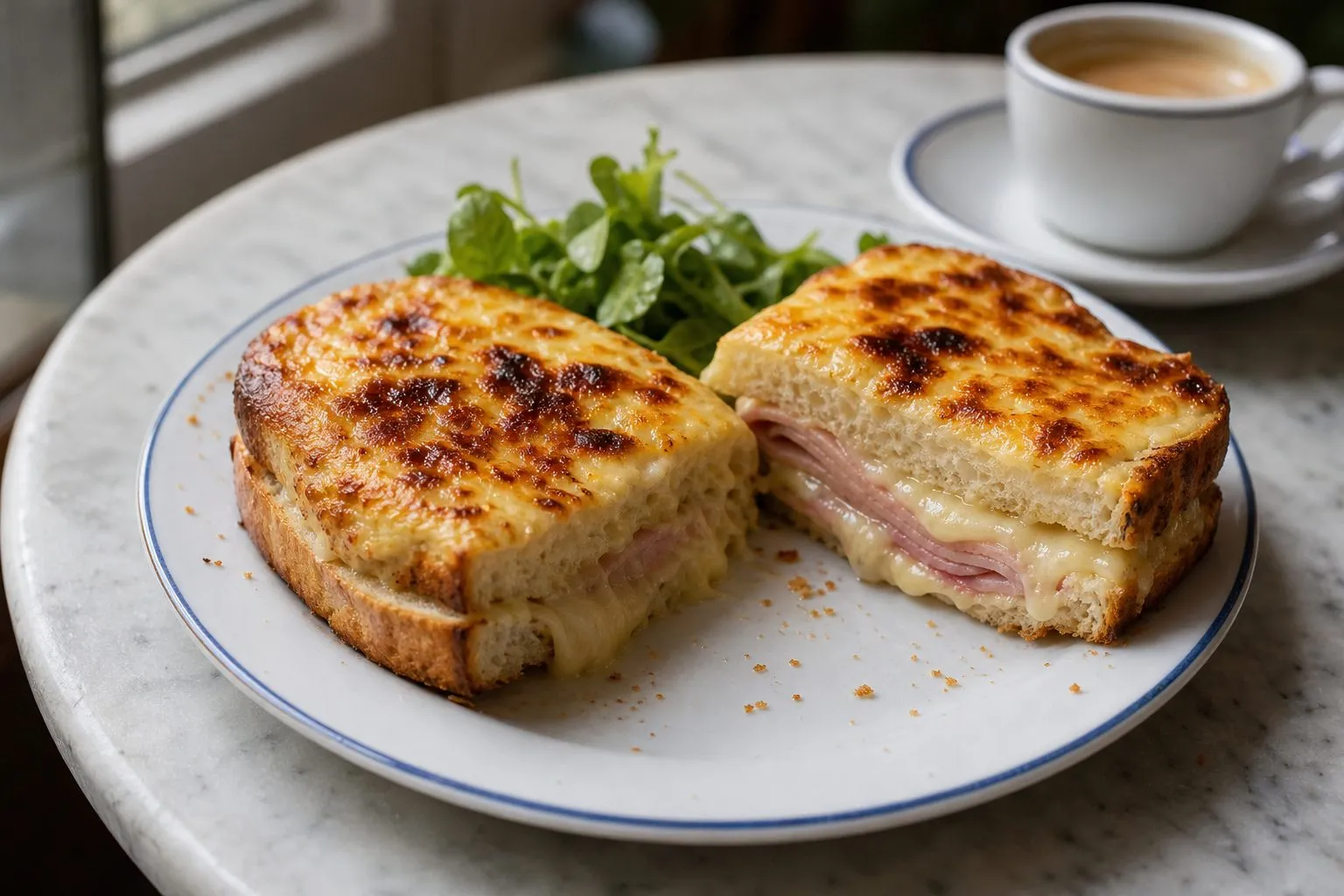
The croque monsieur is a hot French sandwich of ham and cheese, baked until golden. It is a staple of Paris cafés and bistros, and a light lunch eaten with a knife and fork.
This recipe makes the version most often seen in Paris today. Ham and Gruyère go between slices of pain de mie (soft sandwich bread baked in a tin), then béchamel sauce and more cheese go on top before baking. The cheese browns on the surface and the inside stays soft and molten.
What is a croque monsieur?
The French spelling is croque-monsieur. Croque is a form of the verb croquer (to bite, to crunch), and monsieur means “mister” or “gentleman”. Why “monsieur” is not clear.
A record from 1891, and a café story from 1910
An early written example of the name dates from 1891, in the French sports magazine La Revue Athlétique. In a travel account of a boating trip in Norfolk, England, the writers make croque-monsieur from toasting bread, butter, Gruyère, ham and a little cayenne pepper, and cook it in a frying pan. The restaurant guide Gault&Millau cites this record and suggests the croque monsieur may not have been born in France. It also notes that it found no English recipe of the time for a toasted sandwich of ham and cheese.
Another story says the name was first used in 1910 at a café on the Boulevard des Capucines in Paris. Guichet du Savoir, a question-and-answer service run by the municipal library of Lyon, presents this account, based on culinary reference works and other sources, with the qualifier “probably”. Gault&Millau likewise says Paris cafés took it up in the 1910s.
Guichet du Savoir also quotes a passage from Marcel Proust’s In Search of Lost Time, in the second volume, In the Shadow of Young Girls in Flower. Madame de Villeparisis says she has asked the hotel to prepare croque-monsieur and eggs in cream.
With béchamel or without
The 1891 record does not mention béchamel. In the description Guichet du Savoir cites, it is a dish of buttered pain de mie with Gruyère and ham, “sometimes” with béchamel added, fried in butter or broiled.
Many modern French recipes do use béchamel. The recipe by Marion Sauveur, a food journalist at the radio station Europe 1, the method of the Paris 4th arrondissement shop Carré Pain de Mie that she features, and one of the recipes on the news site Demotivateur all include it. The venues Gault&Millau lists are split between those that use béchamel and those that do not.
This recipe uses the oven-baked version with béchamel, the finish you often see in Paris cafés. Béchamel and cheese layered on top bake into a gratin-like crust and keep the bread inside moist. The version without béchamel appears below, under “Variations”.
When and where it is eaten
In France it is a light meal at lunch or in the afternoon, served at cafés, bistros and brasseries (casual restaurants). Charcuteries (shops selling ham and prepared foods) and bakeries sometimes sell it to take away.
Croque-monsieur recipe: ingredients (Makes 4 (serves 4))
Prep 30 min (includes 20 min to cool the béchamel)Cook 25 minDifficulty Medium
Béchamel sauce
- Unsalted butter30 g (2 Tbsp)
- All-purpose flour30 g (about ¼ cup)
- Whole milk (straight from the fridge, cold)300 ml (1¼ cups)
- Salt2 g (⅓ tsp)
- White pepper (ground)0.3 g (⅛ tsp)
- Nutmeg (ground)0.3 g (⅛ tsp)
Assembly
- Pain de mie (soft sandwich bread) (slices about 15 mm / ⅝ in thick)8 slices
- Unsalted butter (softened at room temperature)20 g (1½ Tbsp)
- Jambon de Paris (unsmoked cooked ham)4 slices (about 160 g / 5½ oz)
- Gruyère (grated; 80 g / 2¾ oz inside and 70 g / 2½ oz on top)150 g (5¼ oz)
Equipment
- Small saucepan (16–18 cm / 6–7 in across)
- Whisk
- Shallow dish or tray (for cooling the béchamel)
- Box grater
- Oven (a toaster oven also works)
- Baking sheet and parchment paper
- Palette knife or spoon (for spreading the béchamel)
Method
Cook the roux
Melt 30 g / 2 Tbsp of butter in the saucepan over medium-low heat. Add 30 g / about ¼ cup of flour and whisk for 2–3 minutes. When fine bubbles form and the thick paste loosens and turns smooth, take the pan off the heat. Do not let it take on any color.
Add the milk and simmer
Add about 75 ml / 5 Tbsp of the 300 ml / 1¼ cups of cold milk and whisk quickly until smooth. Add the rest in three batches, whisking well each time. Return the pan to medium heat and keep stirring from the bottom. When it starts to bubble, lower the heat and simmer for 2–3 minutes. It is thick enough when sauce dripped from the whisk leaves a trail on the surface that does not disappear right away. Turn off the heat and stir in 2 g / ⅓ tsp of salt, 0.3 g / ⅛ tsp of white pepper and 0.3 g / ⅛ tsp of nutmeg.
Cool the béchamel
Spread the sauce flat in a tray and press plastic wrap directly onto the surface. Leave it for about 20 minutes. It is ready when you can touch it with a finger and it holds on a spoon without running off. While it cools, grate 150 g / 5¼ oz of Gruyère.
Dry the bread
Heat the oven to 200 °C / 400 °F. Lay the 8 slices of bread on a baking sheet (do it in two batches if they do not all fit) and bake for 2–3 minutes to dry the surface. Do not let them brown. Take the sheet out and let the bread cool on it, then line the sheet with parchment paper.
Sandwich the ham and cheese
Spread a thin layer of the softened 20 g / 1½ Tbsp of butter on one side of each of the 8 slices. Place 4 slices buttered side up on the parchment and spread about 100 g / 3½ oz of béchamel over them (about 25 g / 1 oz per slice). Lay a slice of ham on each and scatter 80 g / 2¾ oz of Gruyère over them (20 g / ¾ oz per sandwich). Cover with the other 4 slices, buttered side down, and press lightly with your palm.
Top with béchamel and cheese
Spread the remaining béchamel (about 200 g / 7 oz, or about 50 g / 1¾ oz per sandwich) over the top slices, all the way to the edges. Scatter 70 g / 2½ oz of Gruyère over them (about 17 g / ½ oz per sandwich).
Bake in the oven
Bake on the upper rack of a 200 °C / 400 °F oven for 10–15 minutes. They are done when the cheese has melted and is bubbling, with deep golden patches. Lift an edge with a spatula: the bottom should be dry and lightly colored. If the top is still pale, switch to the broiler (top heat) for 1–2 minutes and watch closely. In a toaster oven, bake as many as fit at a time for 6–8 minutes, and cover with foil if the top is about to burn before the cheese melts.
Rest 2–3 minutes and cut
Move the sandwiches from the sheet to a plate and let them rest for 2–3 minutes so the cheese and béchamel inside settle. Then cut each in half with a knife.
Eat it hot, with a knife and fork. Add a green salad and a coffee or a glass of white wine, and it becomes a Paris café lunch.
The cheese and béchamel are extremely hot when it comes out, and so is the baking sheet. Use oven mitts, and do not bite in right away.
The science: why you cook the roux, simmer it and cool it
Cooking flour in butter prevents lumps
Béchamel is a sauce of roux (flour cooked in butter) thinned with milk and simmered. If you add flour straight to milk, the outside of each clump absorbs liquid and seals first, leaving dry flour inside, and that is how lumps form. Cooking the flour in butter first coats every grain in fat. The grains do not stick together when the milk goes in, so they spread evenly.
The 2–3 minutes of cooking drives off the raw flour smell. Cook it until it colors, however, and the heat breaks down the starch so it thickens less. For a white béchamel, stop before any color appears.
Starch gelatinization: the sauce is not thick until it nearly boils
The thickening comes from the starch in the flour. When starch granules are heated with water they swell, and starch molecules that escape from the granules get in the way of the flowing liquid. This is gelatinization. Wheat starch starts to swell somewhere between 50 and 70 °C / 120 and 160 °F, but full thickness only comes close to boiling. That is why you simmer for 2–3 minutes once it bubbles. Stop earlier and the sauce runs loose in the oven.
Cooling firms it up, so it soaks into the bread less
As gelatinized starch cools, its molecules gather again into a network and the sauce firms. Cooled béchamel is easy to spread and soaks into the bread less. In the oven the network loosens again and it turns creamy. Spread it warm and the bread absorbs the moisture and the bottom turns soggy.
The science: how cheese melts, and how bread browns
Why Gruyère melts smoothly
Cheese is a network of milk protein (casein) that holds fat and water. When it is warmed, the fat softens first at about 30–39 °C / 85–100 °F. As the temperature rises further, the protein network loosens and the cheese melts and flows. According to the food scientist Harold McGee, firm cheeses such as Gruyère and Cheddar melt at about 60–65 °C / 140–150 °F. Parmesan, which is drier and aged longer, does not melt until it reaches about 80–89 °C / 175–190 °F.
In Gruyère, Comté and Emmental the protein network is broken down to just the right degree during ripening. When melted they stretch and spread smoothly, and bind the ham and bread together. Grating the cheese makes all of it melt at the same rate.
How the cheese and bread get their color
When water leaves the surface of melted cheese, its temperature climbs past 100 °C / 212 °F. Proteins and sugars then react to give browning and a toasty aroma. This is the Maillard reaction. Deep brown patches on the top cheese show that the surface has dried and heated up.
Overbake it, though, and the protein network shrinks and squeezes out fat, leaving the cheese tough and greasy. That is why the bake is kept to 10–15 minutes: take it out once it bubbles and colors.
Pain de mie often contains milk and sugar, so it browns sooner than a crusty bread. The part touching the wet béchamel, on the other hand, stays at about 100 °C / 212 °F while moisture remains, and does not brown. Drying the bread surface first keeps the bottom from going damp and lets it color lightly.
Variations
Without béchamel
As in the 1891 record, you can sandwich ham and Gruyère between buttered bread and cook it in a frying pan. The Clermont-Ferrand venue Comptoir Central des Bazars, which Gault&Millau features, does not use béchamel either.
For the pan version, spread a thin layer of butter on the outside of the bread and put ham and grated Gruyère inside. Cook over medium-low heat for 3–4 minutes per side, pressing gently with a spatula, until both sides are golden and the cheese inside has melted. The outside is crisp and toasty, and it is quicker than the béchamel version.
Demotivateur also has a recipe that skips the béchamel. It spreads a mixture of grated cheese, egg and crème fraîche (cultured cream) on the bread and cooks it in a frying pan.
Different cheeses and breads
The Europe 1 recipe says that besides Comté you can use Cantal or tomme. Among the venues Gault&Millau features, a shop in Rodez in the Aveyron, in southern France, uses Laguiole, and a Lyon shop uses Reblochon. Some use a house-made dough with grains and hazelnuts instead of pain de mie.
Croque madame
A croque monsieur topped with a fried or poached egg is called a croque madame. Some venues in the Gault&Millau article serve a madame alongside the monsieur. In parts of Normandy it is also said to be called croque à cheval (a croque on horseback). To make one, top each baked croque monsieur from the recipe above with a fried egg with a runny yolk.
Substitutions
- Pain de mie. French pain de mie is a soft, thin-crusted bread baked in a tin, much like standard sandwich bread. Slices about 15 mm / ⅝ in thick work well. Many sandwich loaves are soft and moist, so dry the surface thoroughly in step 4. With thicker slices (about 2 cm / ¾ in), the top is likely to burn before the cheese inside melts.
- Gruyère. A firm cheese from the Gruyère region of Switzerland, found at specialty cheese shops. French Comté or Emmental, the kind with holes, can stand in for it. The Europe 1 recipe and the shop it features also name Comté. If you can find none of them, a pizza-style shredded cheese blend also works, though the flavor is milder and the result stretchier.
- Jambon de Paris. A cooked ham that originated in Paris. According to Europe 1, a pork leg is cured in brine, boiled, boned, packed into a mold, then pressed and cooled. In the ingredient list of the same recipe it is called jambon blanc (white ham). Any unsmoked, boneless cooked ham cut from the leg comes close in flavor. Other cooked hams will also work, but avoid strongly smoked ones.
- White pepper. The source recipe says only “pepper”. This recipe uses white pepper to suit the white sauce, but black pepper works too. You will see black specks in the white sauce, and the flavor changes little.
If something goes wrong
- The béchamel has lumps. The milk went in all at once, or the pan went on the heat before the roux and milk were fully mixed. Take it off the heat and whisk hard. If lumps remain, strain it through a fine sieve.
- The béchamel ran out when baked. It was not simmered long enough after boiling, so the starch did not gelatinize fully, or it was spread without cooling. Simmer until the whisk leaves a trail, then cool it before spreading.
- The bottom is soggy. The bread surface was not dried, or warm béchamel was spread on it. Dry the bread in step 4, and cool the béchamel well in step 3.
- The cheese is tough and greasy. It was overbaked. Take the sandwiches out when the cheese bubbles and colors in patches. If the top is pale, give it just 1–2 minutes under the broiler at the end rather than extending the bake.
Storage
This is meant to be eaten hot, straight from the oven. Left sitting, the bread absorbs moisture from the béchamel and goes limp.
- Béchamel: press plastic wrap onto the surface and refrigerate for up to 2 days. It firms up, so work it well with a rubber spatula until spreadable before using.
- Assembled sandwiches (up to step 6): cover with plastic wrap, refrigerate, and bake the same day. They go in cold, so allow 2–3 minutes more and judge by color and bubbling.
Sources
- Europe 1: "Le croque monsieur au véritable jambon de Paris" (French)
- Europe 1: "Nos astuces pour réussir (facilement) un bon croque-monsieur" (French)
- Gault&Millau: "Où manger un bon croque-monsieur ?" (French)
- Demotivateur: "Réalisez le croque-monsieur original, une recette classique et incontournable !" (French)
- Demotivateur: "Croustillez pour le croque-monsieur à la poêle, une recette généreusement gourmande et facile à faire" (French)
- Paris Match Belgique: "La recette comfort food de la rentrée : Le Croque Monsieur au jambon cuit revisité" (French)
- Guichet du Savoir: "L'origine du mot "croque-monsieur"" (French)
- word histories: "‘croque-monsieur’: meaning and origin" (English)
- Wikipedia: "Croque monsieur" (English)
The text and recipe above were put together independently after comparing these sources.