Eggs BenedictEggs Benedict recipe
Eggs Benedict
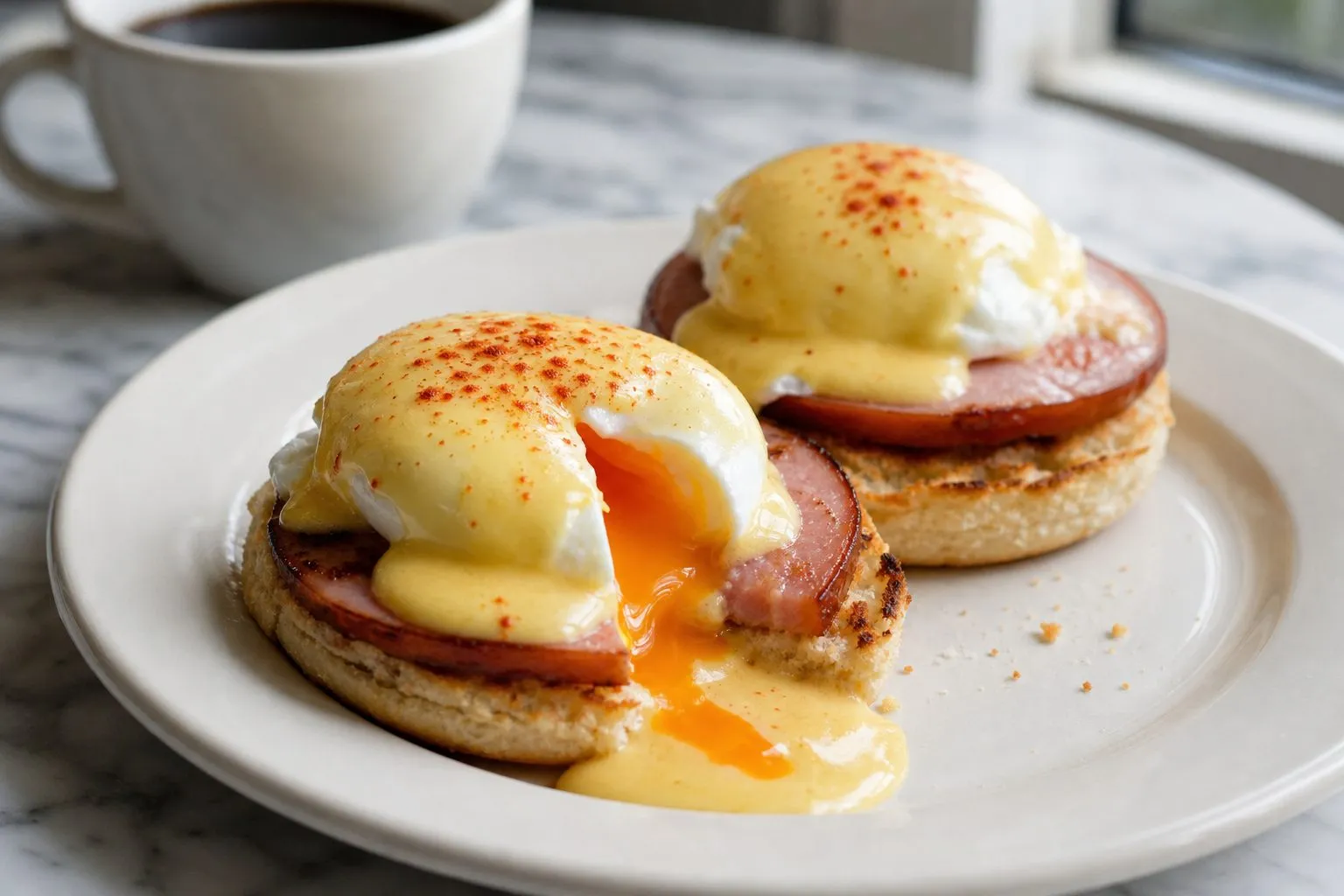
Eggs Benedict is a toasted English muffin topped with Canadian bacon and a poached egg, then covered with hollandaise, a sauce of butter and egg yolk. It is said to have been born in New York in the late 19th century, and it is a classic American breakfast and brunch dish.
It looks difficult, but it comes down to two things. Bring the poaching water to a boil and turn off the heat before the eggs go in. And do not let the hollandaise get too hot. The muffins can simply be store-bought.
What is eggs Benedict?
“Benedict” is a person’s name, supposedly that of the first person to order the dish. Two main stories name two different people, and neither is backed by firm records.
The Delmonico’s story
One story says it began at Delmonico’s, the long-established New York restaurant. A regular guest, Mrs. LeGrand Benedict (some tellings say Mr. and Mrs. Benedict), is said to have complained that nothing on the menu was new and asked for something different. The chef, Charles Ranhofer, is said to have invented the dish. Delmonico’s states on its own menu that the dish was born there in 1860.
Ranhofer’s 1894 cookbook The Epicurean does include a dish called “Eggs à la Benedick.” It is a muffin half toasted without browning, topped with a round slice of ham about 3 mm (⅛ in) thick and a poached egg, covered with hollandaise.
The Waldorf Hotel story
The other story places it at the Waldorf Hotel, the forerunner of today’s Waldorf Astoria. In 1894, a Wall Street stockbroker named Lemuel Benedict is said to have come in on a hungover morning and ordered buttered toast, crisp bacon, two poached eggs and hollandaise. The maître d’hôtel, Oscar Tschirky, supposedly put it on the menu after swapping the toast for an English muffin and the bacon for ham (some accounts say Canadian bacon rather than ham).
Benedict himself told this story in 1942 to The New Yorker’s “Talk of the Town” column, less than a year before he died. Tschirky had been the maître d’hôtel at Delmonico’s before he moved to the Waldorf.
There are other accounts too. In a 1967 letter to the New York Times food writer Craig Claiborne, a man named Edward P. Montgomery wrote that the dish was devised by Commodore E. C. Benedict. In print, the name “eggs a la Benedict” appears in a luncheon menu in a feature in the New-York Daily Tribune of January 7, 1894.
When it is eaten
In the United States it is a staple of breakfast and brunch, and it is a common item on the breakfast and brunch menus of restaurants, diners and hotels.
Eggs Benedict recipe: ingredients (Serves 2 (4 halves))
Prep 10 minCook 25 minDifficulty Medium
Hollandaise sauce
- Egg yolks2 (about 36 g / 1¼ oz)
- Water15 ml (1 Tbsp)
- Lemon juice15 ml (1 Tbsp)
- Unsalted butter115 g / 4 oz (1 stick)
- Salt1 g (⅙ tsp)
- Cayenne pepper (or another ground hot chili)0.2 g (⅒ tsp)
- Water for thinning the sauceup to 15 ml (1 Tbsp)
- Water for the water bath (about 4 cm / 1½ in deep in an 18–20 cm / 7–8 in pot)1 L (about 4 cups)
Poached eggs
- Eggs (very fresh)4 (about 200 g / 7 oz shelled)
- Water (about 5 cm / 2 in deep in a 20 cm / 8 in pot)1.5 L (about 6 cups)
- Vinegar (distilled white vinegar or white wine vinegar)15 ml (1 Tbsp)
- Salt5 g (scant 1 tsp)
Base
- English muffins (store-bought)2
- Canadian bacon (or 3–5 mm / ⅛–¼ in thick slices of ham)4 slices (about 100 g / 3½ oz)
For cooking and spreading
- Unsalted butter (5 g / 1 tsp for browning the bacon and 5 g / 1 tsp for the muffins)10 g (2 tsp)
To finish
- Salt0.5 g (1⁄12 tsp)
- Cayenne pepper (or another ground hot chili)0.1 g (1⁄20 tsp)
Equipment
- Small saucepan (for melting the butter)
- Pot for the water bath (18–20 cm / 7–8 in across)
- Whisk
- Stainless steel bowl (for the water bath; wide enough to sit on the rim of the pot)
- Lidded pot (for the poached eggs; about 20 cm / 8 in across)
- Skillet
- Toaster oven (or a toaster or broiler)
- Fine-mesh sieve (to drain off the watery egg white)
- Slotted spoon
- Kitchen thermometer (optional)
Method
Melt the butter
Put 115 g / 4 oz of unsalted butter in a small saucepan and melt it over low heat. When it starts to foam, turn off the heat and keep it warm. Poke around the edge of each of the 2 English muffins with a fork, then pull them apart into halves with your hands.
Warm the yolks over a water bath
Bring 1 L (about 4 cups) of water to a boil in the water-bath pot, then lower the heat until only small bubbles rise from the bottom. Set the stainless steel bowl on top so its base does not touch the water. Add the 2 egg yolks, 15 ml (1 Tbsp) of water and 15 ml (1 Tbsp) of lemon juice, and whisk without stopping. After 3–6 minutes the mixture turns pale and thick, and the whisk leaves trails. (With a thermometer, aim for 60–65 °C / 140–150 °F.) If the yolk starts to set at the edge of the bowl, lift the bowl off the heat right away and keep whisking.
Whisk in the butter
Take the bowl off the pot and set it on a damp kitchen towel. Add the melted butter a few drops at a time, whisking after each addition. As the sauce thickens, pour the butter in a thin stream while you keep whisking, until it is all in. Leave the white milk solids at the bottom of the pan behind. Whisk in 1 g of salt and 0.2 g of cayenne. If the sauce is too thick, thin it with water, 5 ml (1 tsp) at a time, up to 15 ml (1 Tbsp) in all.
Keep the sauce warm
Turn off the heat under the water-bath pot and let it cool until it hardly steams (about 60 °C / 140 °F). Set the bowl back on top to keep the sauce warm, whisking now and then. Use it within 1 hour. The water is hot, so hold the bowl with a dry towel.
Boil the poaching water
Bring 1.5 L (about 6 cups) of water to a boil over high heat in the lidded pot. Add 15 ml (1 Tbsp) of vinegar and 5 g of salt.
Drain off the watery white
While the water heats, crack the eggs one at a time into a fine-mesh sieve. Wait about 30 seconds and discard the thin white that runs through. Slide each egg into its own small cup.
Turn off the heat and poach the eggs
When the water boils, turn off the heat. Hold the cups close to the surface and slip the 4 eggs in at separate spots (dropping them from a height splashes hot water). Cover at once and let them sit for 3–4 minutes. They are done when the white is opaque all the way over the top and the yolk feels soft and springy when you lift an egg with a slotted spoon and press it gently. If any white is still clear, put the egg back in the water and check every 30 seconds. Lift the eggs out with the slotted spoon and drain them on paper towels.
Brown the bacon and toast the muffins
While the eggs poach, melt 5 g / 1 tsp of unsalted butter in a skillet over medium heat. Cook the Canadian bacon for 1–2 minutes per side, until the edges are lightly browned. Toast the muffin halves in a toaster oven for 2–4 minutes, until golden and crisp, and spread the cut sides with the other 5 g / 1 tsp of butter.
Assemble
Set the muffin halves cut side up on plates. Top each with a slice of Canadian bacon and then a poached egg. Sprinkle the eggs with 0.5 g of salt and spoon about 2 Tbsp (30 ml) of hollandaise over each. Dust with 0.1 g of cayenne and serve immediately.
Serve with black coffee or orange juice.
The science: poached eggs
Why you turn off the heat
Egg proteins set as they heat. Egg white begins to set at 60–65 °C / 140–150 °F and gets firmer as the temperature rises. Yolk sets at 62–70 °C / 145–160 °F. To keep the yolk soft, set the outside of the white quickly and take the egg out before the heat reaches the center.
If you drop an egg into water at a rolling boil, the bubbles tear the white apart and scatter it, and the outside tends to turn hard. If you turn off the heat under boiling water and cover the pot, the water stays hot enough to set the white but goes calm, and the steam under the lid sets the top of the white too. This is the method recommended by America’s Test Kitchen, the publisher of Cook’s Illustrated.
Why fresh eggs, and why drain the thin white
The white of a cracked egg has two parts: thick white, which stands up around the yolk, and thin white, which runs outward. Thin white streams away in the water in wispy strings.
According to an America’s Test Kitchen article, about 60% of the white in a fresh egg is thick white, and this falls below 50% as the egg ages. Choosing very fresh eggs and draining off the thin white in a sieve gives you a compact, round poached egg.
Why vinegar and salt
Acid lowers the pH of the water and makes egg-white proteins set faster. Salt does the same. The surface of the white sets quickly, so it spreads less.
But if you rely on vinegar alone, you need more of it, and the eggs taste sour. Using vinegar and salt together lets you use less of each.
The science: emulsifying hollandaise
Egg yolk joins water and butter
Hollandaise is melted butter broken into tiny droplets and dispersed in egg yolk, lemon juice and water. Fat and water normally separate, but lecithin in the yolk coats the surface of each droplet and keeps the droplets from joining. The result is an emulsion.
Adding the butter a few drops at a time at the start means the yolk only has to coat a little fat at once. If you add a lot at the start, the fat the yolk cannot coat gathers together and the sauce splits. The water is included to help keep the emulsion stable (according to an American culinary-school textbook).
Too hot or too cold, it splits
Warmed over a water bath, the yolk thickens. According to a culinary-school textbook from Nicholls State University, if the sauce goes above 65 °C / 150 °F, the yolk overcooks and the sauce turns grainy and splits. If it gets so cold that the butter solidifies, it splits as well. That is why the water bath must not boil and the bowl must not touch the water. Keep the finished sauce warm over the pot after you have turned off the heat.
How to fix a split sauce
If the sauce looks grainy or the oil floats on top, first work out whether it is too hot or too cold. If too hot, let it cool a little. If too cold, warm it over the water bath.
If that does not bring it back, put 15 ml (1 Tbsp) of water in a clean bowl and whisk the split sauce into it a little at a time. If the sauce overcooked or you added too much butter, add one egg yolk to the water first, then whisk in the split sauce.
About runny eggs
In this dish the yolk is soft, and the yolks in the hollandaise are not fully cooked. Use fresh eggs. If you are serving anyone who is pregnant, small children or older people, cook the poached eggs until the yolks are firm. For the sauce, there is a method that adds more hot water to the yolks and heats the sauce to 71–74 °C / 160–165 °F (America’s Test Kitchen).
Variations
Versions with a different base or sauce are common.
- Eggs Florentine: spinach on top (sometimes instead of the Canadian bacon).
- Eggs Royale: smoked salmon in place of the Canadian bacon.
- Eggs Sardou: from New Orleans. Poached eggs and hollandaise over artichoke bottoms and creamed spinach.
Substitutions
- Canadian bacon. This is a lean, round, cured and smoked bacon made from pork loin. Regular strip bacon is made from the belly, so it is fattier and usually cut thin. Use ham or back bacon (cured pork loin) sliced 3–5 mm / ⅛–¼ in thick. The dish in Ranhofer’s book, which is behind the Delmonico’s story, also uses ham.
- English muffins. Store-bought muffins are fine. Poking holes around the edge with a fork and pulling the muffin apart by hand, rather than cutting it with a knife, leaves a craggy surface that soaks up the butter and sauce.
- Cayenne pepper. Use the same amount of another ground hot chili.
- Lemon juice. Bottled lemon juice works.
If something goes wrong
- The poached eggs fell apart. The eggs were old, or the water was still boiling when you added them. Use fresh eggs, drain off the thin white in a sieve, and turn off the heat before adding the eggs.
- The yolks set hard. They cooked too long. Take one egg out at 3 minutes and press the yolk to check.
- The sauce is grainy or the oil floats. The water bath was too hot, or the butter went in too fast. Fix it as described in “How to fix a split sauce” above.
- The sauce is thin and will not thicken. The yolks were not warmed long enough. Put the bowl back over the water bath and warm it gradually, whisking.
Storage
Eggs Benedict is meant to be eaten right after it is made. Do not make the hollandaise ahead, and keep it warm for no more than 1 hour.
Only the poached eggs can be cooked ahead. Move them into ice water as soon as they are done. To serve, slip them into gently simmering water for 1 minute to reheat, and drain them on paper towels.
To cook them a day or more ahead, move them into cold water (ice water if you have more than 4), and refrigerate them in the water. America’s Test Kitchen gives up to 3 days in the refrigerator. To reheat, put the eggs in 1.5 L (about 6 cups) of water at about 65 °C / 150 °F, cover, and let them sit for 3 minutes.
Sources
- Saveur: "Eggs Benedict" (English)
- Food Network: "Traditional Eggs Benedict" (English)
- America's Test Kitchen: "Easier Eggs Benedict with Foolproof Hollandaise" (English)
- America's Test Kitchen: "Perfect Poached Eggs" (English)
- America's Test Kitchen: "How to Make Poached Eggs up to 3 Days In Advance" (English)
- LibreTexts (Nicholls State University): "1.8: Hollandaise Based Sauces (Flavors of the Saucier)" (English)
- LibreTexts: "1.4: Coagulation (Chemistry of Cooking)" (English)
- The Big Apple (Barry Popik): "Eggs Benedict" (English)
- 6sqft: "How an 1894 Hangover Created an Eggs Benedict Controversy in New York City" (English)
- Wikipedia: "Eggs Benedict" (English)
The text and recipe above were put together independently after comparing these sources.