Full English breakfastFull English Breakfast recipe
Full English breakfast
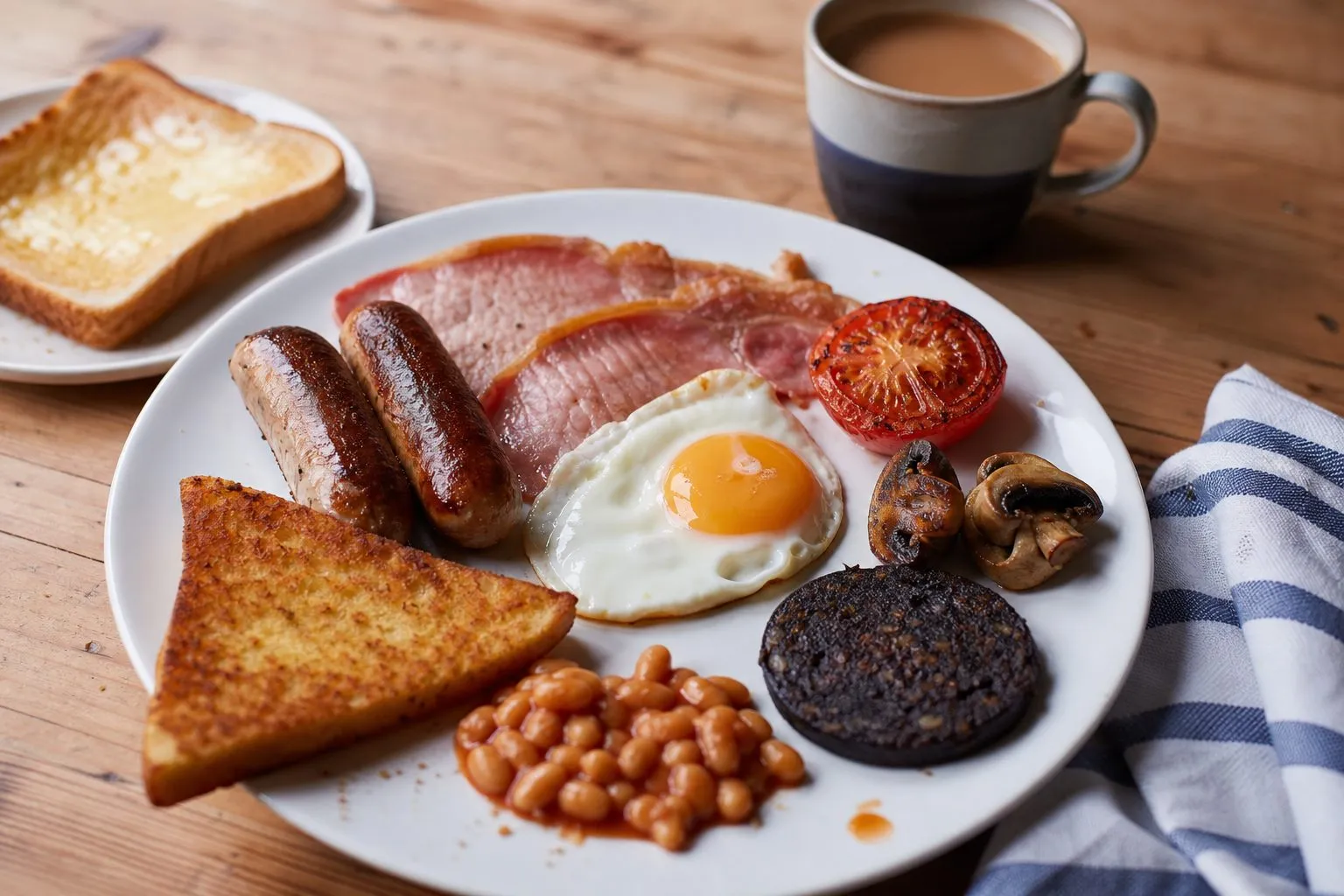
A full English breakfast is an English plate of bacon, sausages, eggs, grilled tomato and mushrooms, black pudding, baked beans and bread, all served together. Most of it is fried, so in Britain it is also called a “fry-up”.
Every item is simple to cook. The hard part is getting everything onto the plate hot at the same time. This recipe starts the slow sausages first over a gentle heat, keeps each finished item warm in a 100 °C / 210 °F oven, and fries the eggs last.
What is a full English breakfast?
It is spelled “Full English breakfast”, and many people shorten it to “a full English”. It is also called “the full monty” in Britain. One theory links that name to General Montgomery, who is said to have eaten this breakfast every morning in North Africa during the Second World War.
From the landowners’ table
Writers disagree about where it began.
The English Breakfast Society, a group that records British breakfast traditions, says it took shape among the rural landowning gentry in the 14th and 15th centuries, after the Norman Conquest (1066). Landowners welcomed guests to their country houses, often before a hunt, with a breakfast of meat and fish from their own estates. The Morning Advertiser, the British pub and hospitality trade paper, also traces it to a breakfast popularized by the gentry, but dates that to the 13th century.
English Wikipedia, citing the food historian Kaori O’Connor and others, says a large cooked breakfast spread clearly only in the 19th century, in the Victorian era. Isabella Beeton’s Book of Household Management (1861) contains breakfast menus. The Morning Advertiser presents them as recommending a full English, but according to Wikipedia the book’s menus are of broiled ham and eggs and never use the phrase “full breakfast”. On this view, the dish was a smaller, middle-class version of the country-house breakfast, for people heading out to work.
Becoming a working person’s breakfast
The English Breakfast Society and Wikipedia both name the Edwardian era (1901–1910) as the peak of this breakfast. The Society says hotels and railway dining cars spread it across the country, and that it settled into its present form then.
The Society says that in the 19th century a working person’s morning meal was mostly bread, porridge or herring, and that only when industrialization made food cheaper could workers afford this breakfast. Wikipedia says it declined after the Second World War because of food shortages, then became the standard working-class breakfast in the 1950s. According to the Society, about half of Britain’s population ate it in the morning in the early 1950s; The Morning Advertiser gives the same figure for the 1950s. The Society also credits cheap cafes near industrial areas and ports, nicknamed “greasy spoons”, with keeping the tradition alive.
What goes on the plate
What belongs on the plate is a common argument, even in Britain.
- English Breakfast Society: The core is back bacon, British pork sausages, eggs, black pudding (a sausage of blood set with oatmeal or another binder), and fried bread or bubble and squeak (leftover roast vegetables fried into a cake). Tomatoes and beans count only as extras. The Society criticizes hash browns (shredded potato fried into a patty) and chips (fries) as untraditional add-ons. Its own recipe for two uses 4 sausages, 6 rashers of bacon and 4 eggs, along with tomato, mushrooms, baked beans, black pudding, bubble and squeak, fried bread and toast.
- BBC Good Food: The recipe from this British food magazine and website, as posted on the British appliance maker Morphy Richards’ site, uses unsmoked back bacon, sausages that are at least 86% pork, poached eggs, mushrooms, vine cherry tomatoes and toasted bread such as whole wheat. There is no black pudding, and baked beans are an optional extra.
- Tesco: The British supermarket’s recipe site gives a lighter version. The sausages, tomatoes and mushrooms bake together in the oven, Parma ham stands in for bacon and the eggs are poached.
- The London Economic: This London online outlet reported on a survey-based “ideal fry-up”: 2 sausages, 2 rashers of bacon, 1 slice of black pudding, 1 hash brown, mushrooms, 1 egg, 1 tomato, 1 slice of fried bread, 1 slice of toast and beans. Of respondents, 42% named tomato ketchup as essential to breakfast, and 34% named brown sauce (a tangy brown condiment).
According to The Morning Advertiser, baked beans became a breakfast staple after a Heinz advertising campaign in the 1960s. Wikipedia says hash browns now commonly appear in place of bubble and squeak. This recipe follows the Society’s recipe and the London Economic survey in serving both fried bread and toast, and, like the Society, leaves out hash browns.
When it is eaten
Wikipedia says that because of health concerns it is eaten less as a daily meal. It is now an occasional meal, or a celebratory or traditional breakfast. Many cafes and pubs serve it all day as an “all-day breakfast”. The survey reported by The London Economic found that people eat it about twice a month on average, and more often at home than in a cafe.
Full English breakfast recipe: ingredients (Serves 2 (2 plates))
Prep 10 minCook 35 minDifficulty Medium
Sausages and black pudding
- British-style pork sausages (raw, not pre-cooked; see Substitutions below)4 (about 240 g / 8½ oz)
- Black pudding (cut into slices)2 slices (1.5 cm / ⅝ in thick, about 100 g / 3½ oz)
- Neutral oil (such as sunflower or vegetable oil)5 ml (1 tsp)
Tomato and mushrooms
- Tomato1 medium (about 150 g / 5¼ oz)
- Brown mushrooms8 (about 120 g / 4¼ oz)
- Neutral oil15 ml (1 Tbsp)
- Fine salt1 g (⅙ tsp)
- Black pepper (coarsely ground)0.2 g (⅒ tsp)
Bacon
- Back bacon (or loin bacon; see Substitutions below)4 rashers (about 100 g / 3½ oz)
Fried bread and toast
- Sliced white bread (about 1.5 cm / ⅝ in thick; 2 slices become fried bread and 2 become toast)4 slices
- Neutral oil30 ml (2 Tbsp)
- Salted butter (for the toast)10 g (about 2 tsp)
Fried eggs
- Eggs (US large (UK medium))2 (about 100 g / 3½ oz total, shelled)
- Neutral oil10 ml (2 tsp)
- Fine salt0.5 g (1/12 tsp)
- Black pepper (coarsely ground)0.1 g (1/20 tsp)
Baked beans
- Canned baked beans200 g / 7 oz (about half a 415 g / 14½ oz can)
Equipment
- Two frying pans (24–26 cm / 9½–10 in. Pan A is for the sausages and eggs; pan B is for the vegetables, bacon and fried bread)
- Small saucepan (to warm the beans)
- Oven (set to 100 °C / 210 °F to keep food warm)
- Heatproof dish (holds the cooked food in the oven; line it with paper towels)
- Toaster oven (or a pop-up toaster, for the toast)
- Tongs
- Paper towels
- Kitchen thermometer (to check the sausages' core temperature; the recipe works without one)
Method
Warm the oven and prep
Heat the oven to 100 °C / 210 °F. Put in the paper-towel-lined heatproof dish and two serving plates. Halve the tomato crosswise. Trim any dirty ends from the mushroom stems and halve the mushrooms lengthwise. Snip or cut 2–3 notches into the fat edge of each bacon rasher. Cut two 1.5 cm / ⅝ in slices of black pudding and peel off any outer casing. Tip 200 g / 7 oz of baked beans into the saucepan. Cut 2 slices of bread in half diagonally into triangles for the fried bread.
Start the sausages
Put 5 ml / 1 tsp of oil in pan A, add the 4 sausages, and only then set it over medium-low heat. Do not prick the skins. Keep the heat low enough for a steady, quiet sizzle and turn the sausages every 2–3 minutes. They need 15–20 minutes in all. If they spit hard or the skins swell tight, turn the heat down.
Cook the tomato and mushrooms
About 3 minutes after the sausages go on, put 15 ml / 1 Tbsp of oil in pan B and heat it over medium to medium-high for 1 minute. Lay the tomato halves and mushrooms cut side down, spaced so they do not touch (keep your face back, because the oil spits). Leave them alone for 3–4 minutes, until the cut sides are browned, then turn and cook 2–3 minutes more. Sprinkle with 1 g of salt and 0.2 g of pepper and move them to the dish in the oven.
Cook the bacon
Turn pan B to medium and lay in the 4 bacon rashers. Cook 2–3 minutes per side, until the fat turns translucent and the edges are lightly golden. Move them to the oven dish. Leave the fat in the pan, because you will fry the bread in it.
Cook the black pudding
About 10 minutes after the sausages went on, add the 2 black pudding slices to any free space in pan A. Keep the heat at medium-low and cook 3–4 minutes per side, until the surface is crisp and browned. They break easily, so turn them gently with tongs.
Check the sausages
At 15–20 minutes the sausages should be deeply browned all over and feel springy when pressed with tongs. If you have a thermometer, wait until the thickest part reaches 75 °C / 165 °F, then cook at least 1 minute more. If not, cut one open on the diagonal: there should be no pink and the juices should run clear. Move the sausages to the oven dish with the black pudding.
Fry the bread
Add 30 ml / 2 Tbsp of oil to the bacon fat in pan B and heat over medium for 1 minute, to 170–180 °C / 340–355 °F. Without a thermometer, drop in a corner of bread: if fine bubbles appear straight away, the oil is ready. The oil spits, so lower the triangles in gently, laying each one down away from you. Fry 1–2 minutes per side until golden and crisp all over. Drain on paper towels, then move them to the oven dish.
Heat the beans and make the toast
While the bread fries, warm the beans in the saucepan over medium-low heat for 3–4 minutes, stirring so the bottom does not catch, until they bubble at the edges. Turn off the heat and cover. Toast the other 2 slices of bread in the toaster oven for 2–4 minutes, until golden.
Fry the eggs
Wipe excess fat out of pan A with paper towels held in tongs (the pan is hot, so do not touch it). Add 10 ml / 2 tsp of oil and set it over medium-low heat. Crack each egg into a small bowl first, then slide it in gently. After 3–4 minutes, when the underside of the white is set and the edges are bubbling, tilt the pan and spoon the hot oil over and around the yolk a few times. Take the pan off the heat when the thin film of white over the yolk has turned opaque and the yolk is still runny. Season with 0.5 g of salt and 0.1 g of pepper.
Plate up
Take the warm plates out of the oven with oven mitts. Arrange the sausages, bacon, black pudding, tomato, mushrooms, fried bread and eggs with a little space between them. Spoon the beans into the empty space or into a small bowl. Put the toast on a separate plate with the 10 g of butter, to be spread at the table. Serve immediately.
In the English Breakfast Society’s recipe it is served with tea or coffee and orange juice, along with tomato ketchup or brown sauce.
The science: why sausages cook slowly over medium-low heat
The outside burns and the skin splits before the middle is cooked
A British-style sausage is raw ground pork mixed with a bread-based binder and packed into a casing. It must be cooked through. Japan’s Ministry of Health, Labour and Welfare advises cooking pork until the center reaches 75 °C / 165 °F and holding it there for at least 1 minute.
Over high heat the surface burns while the middle stays raw. The water inside turns suddenly to steam and swells, so the skin stretches tight and splits. According to the English Breakfast Society, sausages are called “bangers” because the thin wartime sausages of the First and Second World Wars, made with a lot of cheap filler that swelled when heated, burst in the pan with a bang. Its recipe also says to cook them evenly and without hurrying so they cook through. Turning them over medium-low heat for 15–20 minutes browns the surface slowly and evenly while the heat reaches the center.
Keeping the juices in
Meat proteins shrink as they heat and squeeze out juice. In On Food and Cooking, Harold McGee explains that this shrinking becomes strong at around 60 °C / 140 °F, and that by 70 °C / 160 °F much of the juice is gone and the meat turns dry. Over high heat the part near the surface gets too hot, the skin splits, and juice and fat run out.
The Society says that some sausages are still prone to bursting if the skin is not pricked before cooking. This recipe does not prick them. Gentle heat and slow cooking prevent bursting. If you prick yours, the heat and timing stay the same.
Why you notch the bacon
The fat edge of a rasher shrinks more than the lean. Left uncut, the edge pulls the rasher into a curl, part of it lifts off the pan, and it browns unevenly. The Society’s recipe also says to snip the fat to stop it curling.
The science: browning tomato and mushrooms, and the fried egg
Water has to cook off before browning starts
Browning and toasty flavor come from the Maillard reaction between protein and sugar, which speeds up once the surface passes about 120–150 °C / 250–300 °F. While there is water on the surface, the temperature stays stuck at around 100 °C / 210 °F.
Mushrooms are roughly 90% water by weight. Packed tightly in the pan, the water they release is trapped and they steam instead of browning. Spaced apart and left alone, the water evaporates quickly and the cut sides brown. The method reported by The Register, devised by the British newspaper the Mirror, also says to move the mushrooms and tomatoes as little as possible so they do not turn watery. Salt goes on last because salting early draws water out sooner.
Tomatoes work the same way. Cut side down in hot oil, the surface water cooks off and the tomato sugars caramelize into a sweet, slightly burnt aroma. If overcooked the flesh collapses and the juice runs out, so after turning, give them only 2–3 minutes.
Fry the egg over medium-low heat and finish by basting
Egg white starts to set at 60–65 °C / 140–150 °F, and the yolk sets at 62–70 °C / 145–160 °F. On high heat the white on the bottom burns and toughens before the white over the yolk has set. Over medium-low heat, finished by spooning hot oil around the yolk, the top white sets without flipping the egg and the yolk stays runny.
Use fresh eggs for a runny yolk. For pregnant people, young children and older people, flip the egg and cook it until the yolk is firm.
Cooking it all in the oven
Some cooks bake the sausages and the rest in the oven instead of the pan. In the method The Register describes, sausages cook for 20 minutes in an oven at 200 °C / 400 °F (180 °C / 350 °F for a fan oven), with bacon added 5 minutes later for 15 minutes. The Tesco recipe bakes the sausages, tomatoes and mushrooms together at 200 °C / 400 °F for 40 minutes, turning them partway through. The browning is more restrained, but your hands are free to focus on the eggs and bread.
Regional variations
Different parts of Britain and Ireland have their own versions of the breakfast (according to Wikipedia).
- Full Scottish (Scotland): square Lorne sausage with no casing, Stornoway black pudding, potato scones known as tattie scones and more.
- Ulster fry (Northern Ireland): fried soda bread and potato bread. Traditionalists cook it only in lard and leave out baked beans and hash browns.
- Full Irish (Ireland): sausages, bacon and eggs at the center, with white pudding (a pudding made without blood), soda bread and more.
- Full Welsh (Wales): served with cockles and laverbread, a paste of boiled seaweed.
Substitutions
- Back bacon. According to the English Breakfast Society, it is made from the pork loin (the lean back meat) with a band of belly fat attached. It sits between American streaky bacon, which is all belly, and Canadian bacon, which is all loin. If you cannot find it, use loin bacon. A rasher with a rim of fat is closer to back bacon than one with no fat at all.
- British-style sausages. These are raw pork sausages mixed with a bread-based binder. The BBC Good Food recipe recommends sausages that are at least 86% pork. Use raw pork sausages from a butcher or the fresh meat counter. If you only have pre-cooked sausages, cook them in step 2 over medium-low heat for about 5–6 minutes, until browned all over and hot through. Move them to the oven dish and then fry the black pudding in the same pan.
- Black pudding. Specialty and online food shops often stock it, sometimes frozen. If you cannot find it, leave it out; the BBC Good Food recipe does not include it either.
- Baked beans. These are white beans (haricot or navy beans) simmered in tomato sauce and sold in cans. Most supermarkets sell them.
- Bread. Use sliced bread about 1.5 cm / ⅝ in thick. As in the BBC Good Food recipe, whole wheat bread is fine.
If something goes wrong
- The sausage skins split, or the outside is burnt and the middle is raw. The heat was too high. Keep it at medium-low, with a quiet, steady sizzle. If the middle is raw, cover the pan and cook on low for a few minutes, then check the core temperature or cut one open.
- The mushrooms give off water and will not brown. The pan was crowded or you moved them too early. Cook them in two batches and leave them alone until they brown.
- The fried bread is greasy. The bread went in before the oil was hot. Test with a corner of bread and wait for fine bubbles to appear at once.
- The egg’s edges are burnt and hard but the yolk top is raw. The heat was too high. Use medium-low and finish by basting with the oil.
Storage
This is a dish to eat freshly cooked. As it sits, the fried bread and toast turn damp and the eggs toughen.
Move leftover baked beans from the can to a container, refrigerate, and eat within 2 days. Refrigerate leftover cooked sausages and eat them by the next day, reheating until hot all the way through.
Sources
- English Breakfast Society: "English Breakfast Recipe" (English)
- English Breakfast Society: "A Short History of the English Breakfast Tradition" (English)
- English Breakfast Society: "A Guide To English Back Bacon" (English)
- English Breakfast Society: "A Guide To British Bangers" (English)
- English Breakfast Society: "A Guide To Traditional Black Pudding" (English)
- Morphy Richards: "How To Make A Full English Breakfast" (English)
- Tesco Real Food: "Full English breakfast recipe" (English)
- The Register: "Revealed: Perfect timings for creation of exemplary full English breakfast" (English)
- The London Economic: "How To Make: The Perfect Full English Breakfast" (English)
- The Morning Advertiser: "The history of breakfast" (English)
- Wikipedia: "Full breakfast" (English)
- Ministry of Health, Labour and Welfare (Japan): "牛・豚のレバーや豚肉は、中までしっかり加熱してください" (Japanese)
The text and recipe above were put together independently after comparing these sources.