Smashed avocadoSmashed Avocado recipe
Smashed avo
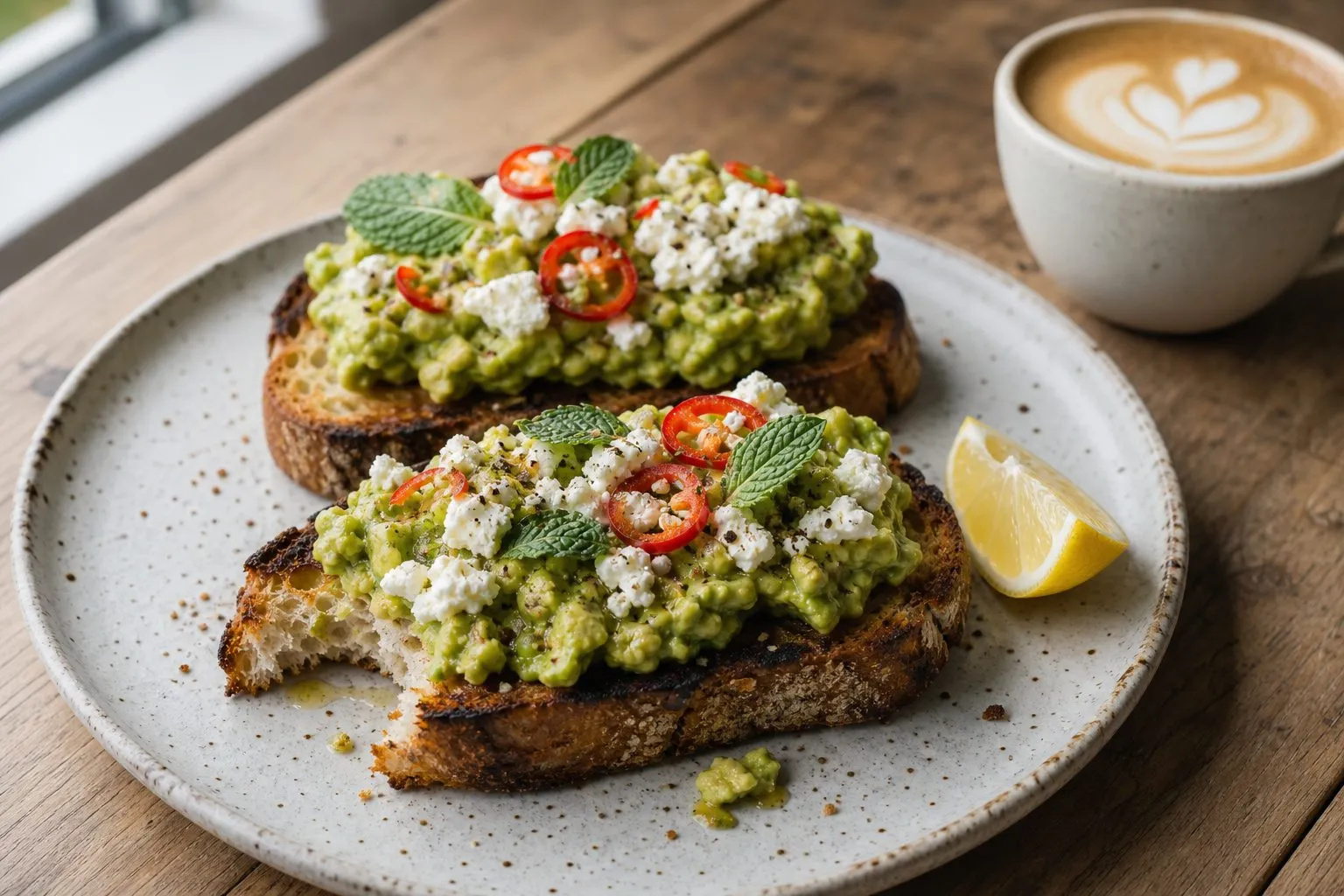
Smashed avocado is coarsely mashed avocado piled onto thick toast, a breakfast staple in Australian cafés. It is usually sharpened with lemon and mixed with crumbled feta (a salty white brined cheese) and herbs, and sometimes finished with chili. In Australia it is shortened to “smashed avo”.
This recipe follows the approach of Australian recipes, including those from the avocado industry site Australian Avocados. It combines lemon juice and zest, feta and mint on sourdough toast, with chili scattered over the top. The only cooking is toasting the bread, and the whole dish takes about 10 minutes.
What is smashed avocado?
In English it is “smashed avocado”, and in Australian slang “smashed avo”. To smash is to crush hard. The aim is not a smooth paste but a rough mash with lumps left in. “Avo” is simply short for avocado.
It spread from the café menu
The Sydney cook Bill Granger is said to have served avocado on toast in 1993 at his café bills in Darlinghurst. In a 2018 Australian article, Granger said it came from looking for something good to go with a breakfast Bloody Mary.
It is not certain, though, that Granger was the first. The Washington Post only goes as far as saying he may have been the first to put it on a modern café menu. Avocado on bread is recorded much earlier than that. According to Oxford University Press Australia, the phrase “smashed avo” itself is Australian, and the earliest example confirmed in print dates from 2011. Avocado toast was already on café menus before that.
The 2016 “smashed avo” row
The dish became a national talking point in October 2016. The demographer Bernard Salt wrote in a column for the weekend magazine of The Australian that young people could save for a house deposit if they stopped repeatedly ordering smashed avocado with crumbled feta on multigrain toast at cafés.
The column drew a huge response in newspapers and on social media. Some cafés cut their prices or renamed the dish. The Australian National Dictionary Centre named “smashed avo” as a candidate for its Word of the Year. Salt later said the column was meant as humorous mockery of baby-boomer conservatism.
When and where it is eaten
It is eaten for breakfast or brunch in cafés in Sydney, Melbourne and other Australian cities. Recipes often top it with a poached egg or add bacon or tomato on the side. It is also well loved as an easy breakfast to make at home.
Smashed avocado recipe: ingredients (Serves 2 (2 slices))
Prep 10 minCook 5 minDifficulty Easy
Smashed avocado
- Avocado (Hass, very ripe)1 large (about 150 g / 5¼ oz flesh, without skin and stone)
- Lemon juice15 ml (1 Tbsp)
- Lemon zest (finely grated) (from an unwaxed lemon)½ lemon (about 3 g / 1½ tsp)
- Extra-virgin olive oil10 ml (2 tsp)
- Salt1 g (⅙ tsp)
- Mint leaves10 leaves (about 2 g)
- Feta (40 g / 1½ oz to mix in and 20 g / ¾ oz to scatter on top)60 g / 2 oz
Toast
- Sourdough bread (a country loaf (pain de campagne) also works)2 slices (about 2 cm / ¾ in thick, about 60 g / 2 oz each)
To finish
- Fresh red chili (a small one)1 (about 3 g)
- Extra-virgin olive oil10 ml (2 tsp)
- Black pepper (coarsely ground)0.2 g (⅒ tsp)
- Lemon wedges2
Equipment
- Knife and cutting board
- Bowl
- Fork (for smashing with the back of the tines)
- Spoon (for removing the stone and scooping out the flesh)
- Fine grater (for the lemon zest)
- Toaster oven (or a broiler / grill)
- Tongs (for taking out the hot toast)
Method
Prepare the ingredients
Set 4 of the 10 mint leaves aside for garnish and roughly chop the other 6. Slice the chili into thin rounds. Finely grate 3 g of zest (from ½ lemon) and squeeze out 15 ml of juice. Cut 2 wedges from the rest of the lemon. Crumble the feta by hand into pieces about 1 cm / ½ in across and divide it into 40 g and 20 g.
Toast the bread
Toast the 2 slices of sourdough in a toaster oven for 3–5 minutes, until the surface is golden and the edges are a little darker. Under a broiler, toast both sides until golden, watching closely. The rack and the inside of the oven are very hot, so take the toast out with tongs.
Open the avocado
While the bread toasts, cut the avocado lengthwise all the way around until the knife meets the stone, then twist the halves apart. Lift out the stone with a spoon (driving the knife blade into the stone is a common way to cut your hand). Scoop the flesh from the skin into a bowl.
Add the lemon and smash
Right away, pour over the 15 ml of lemon juice and add the 3 g of zest, then smash coarsely with the back of a fork. Stop when about half of it is still in lumps of 1–2 cm / ½–¾ in. Add 10 ml of olive oil, 1 g of salt, the chopped mint and 40 g of feta, and fold in with the fork 2 or 3 times.
Pile on and finish
Divide the avocado between the hot slices and pile it on, spreading it out to the edges and leaving the top rough. Scatter over the remaining 20 g of feta, the chili and the reserved mint leaves, drizzle with 10 ml of olive oil and sprinkle with 0.2 g of black pepper. Serve at once with a lemon wedge.
A flat white (espresso topped with finely textured steamed milk and very little foam) goes very well with it. Smashed avo and a flat white together call to mind an Australian café breakfast.
The science: why cut avocado turns brown
Enzyme plus oxygen changes the color
Avocado flesh contains polyphenols (plant compounds of the phenol family) and an enzyme that oxidizes them, polyphenol oxidase. Normally they sit in different parts of the cell, so nothing happens.
When you cut or smash the fruit, the cells break open and the two mix and react with oxygen in the air. The products link together into brown pigments. This is called enzymatic browning, and it is the same thing that browns cut apples and bananas (Harold McGee, On Food and Cooking).
Smashed avocado has far more broken cells and far more surface exposed to air than slices do, so it changes color faster.
Why the lemon juice goes on right away
This enzyme works more slowly in acid, so the acid in lemon juice slows browning. Lemon juice also contains vitamin C (ascorbic acid), which converts the precursors of the pigment back to their original form and delays the color change further (McGee). In a Brazilian study, adding ascorbic acid to guacamole suppressed the enzyme and helped preserve its quality during frozen storage (Daiuto et al., 2011).
That is why step 4 adds the juice before smashing. As you smash, the juice spreads through the avocado and the acid reaches the broken cells at once.
You may hear that leaving the stone in prevents browning. Browning is caused by contact with oxygen, so any surface the stone does not cover will still turn brown. To store leftovers, press plastic wrap right onto the surface to shut out the air.
The science: telling when an avocado is ripe
Avocados ripen after they are picked
Avocados do not ripen while they are on the tree; they ripen after harvest (McGee). The fruit gives off ethylene gas, which acts as the signal, and the cell walls and the material that holds cells together break down so the flesh softens. A ripe avocado is soft, and even when coarsely smashed the lumps have a smooth texture.
Press gently around the stem
John Tyas, CEO of the growers’ body Avocados Australia, gave this advice in an interview with RoyalAuto, the member magazine of the Australian motoring club RACV:
- Press gently around the stem end with a finger. If it gives slightly, it is ready to eat.
- Hass avocados darken in skin color as they ripen. Some varieties stay green when ripe (for example the Australian Shepard).
- If the stem is missing, the fruit tends to spoil from that spot.
- Firm fruit should ripen at room temperature, out of direct sunlight, and go in the fridge once ripe. Chilling before it ripens can leave it stuck unripe.
- Keeping it next to bananas and similar fruit starts ripening with their ethylene.
Hass, with its bumpy skin, is the variety you will see most often in many markets. Choose one whose skin has darkened and whose stem end gives slightly. Soft flesh bruises easily and a hard squeeze leaves dark marks, so press gently.
How it differs from café to café
Reading six Australian recipes (three of them from Australian Avocados) side by side, lemon appeared in all six and feta in four. Beyond that, cafés and home cooks vary.
- Bread: Sourdough is the most common, though rye and multigrain are also used. Some recipes brush the bread with olive oil, grill it on a ridged pan and rub it with a cut garlic clove. Others butter it.
- Cheese: Feta, but also ricotta and goat’s cheese.
- Herbs: Mint, but also cilantro (coriander), parsley, dill and chives.
- Toppings: Poached egg, bacon, tomato, arugula (rocket), dukkah (an Egyptian blend of crushed nuts and spices) and more.
- Vegemite: A salty black spread made from yeast extract, common in Australian homes. Some people spread a thin layer on the toast before adding the avocado.
Substitutions
- Sourdough: A naturally leavened bread with a sour tang and a firm crust. Use a country loaf or rye bread cut about 2 cm / ¾ in thick. With sandwich bread, choose thick slices of about the same thickness and toast until the surface is well browned.
- Feta: Traditionally made from sheep’s milk (sometimes blended with goat’s milk) and kept in brine; versions made with cow’s milk are also sold. Cheeses made from unpasteurized milk carry a risk of Listeria food poisoning, and Japan’s Ministry of Agriculture, Forestry and Fisheries advises pregnant people to avoid them. If you are pregnant, check the label to see that the cheese is made from pasteurized milk. If you cannot find feta, use the same 60 g / 2 oz of ricotta (Australian Avocados has a recipe that uses ricotta). It will be milder and less salty and tangy than feta.
- Fresh red chili: Finish with dried chili rings (about one chili’s worth) or 0.2 g (⅒ tsp) of chili flakes.
- Mint: Use the same amount of flat-leaf parsley or cilantro (coriander) leaves.
- Lemon zest: If you cannot get an unwaxed lemon, leave out the zest and make it with the juice alone.
If you touch your eyes or face after cutting chili, it will sting. Wash your hands as soon as you have finished cutting.
If something goes wrong
- It turned brown. The avocado sat too long after smashing, or the lemon juice went in late. Open the avocado only after the bread is in the toaster, and add the juice before smashing.
- It is a watery paste. It was smashed or mixed too much, or the avocado was overripe. Press with the fork fewer times, and fold only 2 or 3 times once the feta is in.
- It is hard, will not smash, or tastes grassy. The avocado is not ripe yet. Leave it at room temperature, out of direct sunlight, until it gives slightly around the stem.
- The toast went soft. The bread was too thin, under-toasted, or topped too long ago. Cut it about 2 cm / ¾ in thick, toast until the edges are well browned, and eat right after topping.
Storage
This is best eaten freshly made. Smashed avocado changes color as it sits, so make it just before you eat.
For a leftover half avocado, sprinkle lemon juice over the cut surface, press plastic wrap right onto it or put it in an airtight container, refrigerate, and use it by the next day. A whole avocado slows down its ripening if you move it to the fridge once it is ripe.
Sources
- Australian Avocados: "Avocado and feta smash" (English)
- Australian Avocados: "Zesty Avocado Toast" (English)
- Australian Avocados: "Crushed avocado on grilled sourdough with mint and ricotta" (English)
- Aveo: "Smashed Avocado & Feta" (English)
- Bake Play Smile (Lucy Mathieson): "Smashed Avocado" (English)
- Football Australia: "Avocado & Feta Smash" (English)
- RACV RoyalAuto: "How to pick the perfect avocado:an expert's guide" (English)
- Farm Online: "Bill Granger celebrates 25 years of smashing avos" (English)
- Oxford University Press Australia: "Oxford Word of the Month - May: smashed avo" (English)
- Broadsheet: "The Smashed Avocado Generation" (English)
- The New Daily: "Middle-Aged Moraliser: ditch the smashed avo" (English)
- Wikipedia: "Avocado toast" (English)
- Ministry of Agriculture, Forestry and Fisheries (Japan): "これから赤ちゃんを迎えるご家庭のための食中毒予防" (Japanese)
- Semina: Ciências Agrárias: "Sensorial, biochemical and microbiological evaluations of guacamole, an avocado based product, under cold storage and added with ascorbic acid" (English, Portuguese)
The text and recipe above were put together independently after comparing these sources.