TiramisùTiramisù recipe
tiramisù
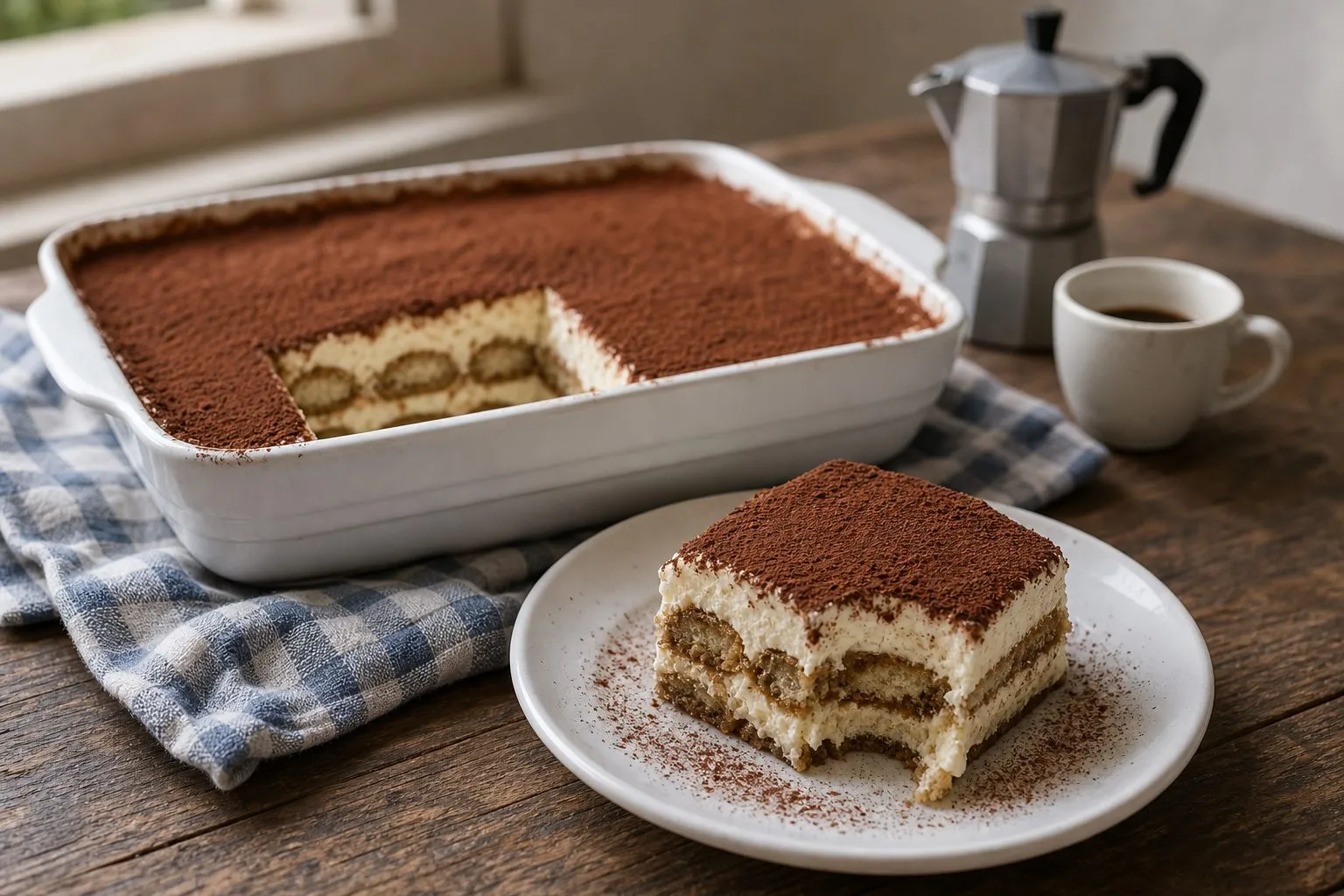
Tiramisù is an Italian dessert of coffee-soaked biscuits layered with a cream of egg yolks, sugar and mascarpone, then dusted with cocoa and chilled. There is no oven and no gelatin. You whip, fold, layer and chill.
This recipe follows the no-alcohol version that is considered the original in Treviso, in northern Italy. It has six ingredients. Versions with Marsala, liqueur, whipped egg whites or cream are covered further down.
What is tiramisù?
In Italian it is spelled tiramisù. “Tira mi su” means “pick me up”, in the sense of “cheer me up”. In the dialect of Treviso it is called Tiramesù.
The Le Beccherie story in Treviso
The best-known account is that tiramisù was born at the restaurant Le Beccherie in Treviso, in the Veneto region. According to the restaurant, it began in 1955. The owner Alba Campeol was pregnant with her son Carlo, and her mother-in-law is said to have made her a sbatutìn, a nourishing mix of beaten egg yolks and sugar, with coffee.
Using that memory as a starting point, Alba worked on trial versions with the restaurant’s pastry chef, Roberto Linguanotto, known as Lolì. The restaurant says the form was settled in 1971–72, and that the dessert appeared on the menu in 1972. Some articles credit Alba together with her husband Ado Campeol, who died in 2021 at the age of 93.
The Treviso food historian Giuseppe Maffioli wrote about the dessert in 1981 in the wine and food magazine Vin Veneto. According to a school teaching text, his 1983 book La cucina trevigiana presents the Le Beccherie tiramisù as the authentic one. In 2010, three members of the Treviso chapter of the Accademia Italiana della Cucina had their research into the method recorded in a notarized deed.
There is another account inside Treviso too. It says that in the early 1960s Speranza Bon Garatti of the restaurant Il Camin was already serving a similar dessert.
The claim from Friuli-Venezia Giulia
The neighboring region of Friuli-Venezia Giulia has claims that it is older.
- Tolmezzo: Norma Pielli of the restaurant Roma is said to have made a sweet with mascarpone. It is reported to be an adaptation of the “dolce Torino” (recipe no. 649) of the 19th-century cookbook author Artusi. Similar names are said to appear on a 1959 bill and in records of 1960s dinners.
- Pieris: The coppa Vetturino of the Cosolo family’s restaurant Il Vetturino is claimed as the forerunner. The food journalists Gigi Padovani and Clara Vada Padovani wrote about it in their book. It layers sponge soaked in Marsala, zabaione and cocoa-flavored whipped cream in a glass, with no mascarpone.
Carlo Campeol, for his part, says the cream is made with mascarpone and contains no whipped egg whites.
The 2017 heritage listing and what followed
In 2017, a decision of Italy’s agriculture ministry added tiramisù to the list of traditional agri-food products (PAT) of Friuli-Venezia Giulia. Veneto’s governor Luca Zaia objected strongly, and the dispute was widely covered in Italy.
There is also a group called the Accademia del Tiramisù. According to Le Beccherie, in 2019 it recognized the restaurant as the place where the true Treviso tiramisù was born. The restaurant’s materials also say that tiramisù was added to Veneto’s PAT list in 2024.
Which came first depends on how you read the records. This article does not pick a side.
The original recipe and today’s home versions
The recipe attributed to Le Beccherie has only six ingredients: egg yolks, sugar, mascarpone, savoiardi, coffee and cocoa. Savoiardi are light Italian finger biscuits. There is no alcohol and no egg white.
Italian home recipes often lighten the cream with whipped egg whites or whipped cream, or add Marsala to the coffee. This article uses the six ingredients only.
The amount of sugar varies a great deal between sources. In the quantities Dissapore, an Italian food site, reported from its visit to Le Beccherie, sugar is half the weight of the mascarpone. In a school teaching text that gives a recipe as the original, it is 1½ tablespoons per yolk. This article uses the second ratio. That text sweetens the coffee lightly, but here the coffee is used unsweetened.
In Italy it is eaten as a dessert after lunch or dinner.
Tiramisù recipe: ingredients (One 20 × 27 cm / 8 × 10½ in dish (serves 8))
Prep 6 hours 30 min (includes 6 hours of chilling)Cook None (chill for 6 hours to overnight)Difficulty Easy
Mascarpone cream
- Egg yolks (from very fresh eggs that are safe to eat raw)5 yolks (about 90 g / 3 oz)
- Granulated sugar100 g (½ cup)
- Mascarpone (straight from the fridge, cold)500 g / 1 lb 1½ oz
Assembly
- Espresso (brewed without sugar and cooled)300 ml (1¼ cups)
- Savoiardi (ladyfingers) (Italian dry finger biscuits)250 g / 8¾ oz (about 30)
To finish
- Unsweetened cocoa powder (pure cocoa, with no sugar or milk powder added)12 g (about 2 Tbsp)
Equipment
- Hand mixer
- Moka pot (stovetop espresso maker) (for brewing the espresso; see Substitutions below if you do not have one)
- Dish or baking pan (about 20 × 27 cm / 8 × 10½ in and at least 5 cm / 2 in deep)
- Fine-mesh sieve (for dusting the cocoa)
- Digital kitchen scale
- Food thermometer (needed only if you heat the egg yolks)
Method
Cool the coffee
Brew 300 ml of espresso without sugar and pour it into a shallow dish. Let it cool to room temperature, then chill it in the fridge. Hot coffee makes the savoiardi fall apart and loosens the cream.
Whip the yolks and sugar
Put 5 egg yolks (about 90 g / 3 oz) and 100 g of sugar in a bowl and beat with a hand mixer on high for 4–6 minutes. It is ready when it has turned pale cream in color and gained volume, and the mixture falling from the beaters folds onto itself in a ribbon that holds for 2–3 seconds. Rub a little between your fingers to check that no sugar grains remain.
Fold in the mascarpone
Add 500 g / 1 lb 1½ oz of cold mascarpone in three portions. Mix the first portion in on low speed for 10–20 seconds. Fold in the second and third with a spatula, scraping up from the bottom, and stop as soon as it is even. The cream should look smooth and glossy, and when scooped, the peaks should fall over softly. Overmixing makes it split and turn grainy.
Make the first layer
Dip each savoiardo in the coffee for 1–2 seconds per side. A small dry core should remain in the center. Arrange about 15 in the bottom of the dish with no gaps, breaking pieces to fill any short spaces. Spread half the cream over them with a spatula, all the way to the edges.
Make the second layer
Dip the remaining savoiardi the same way and lay them over the first layer of cream. Top with the rest of the cream and smooth the surface.
Chill
Cover loosely with plastic wrap that does not touch the cream, and refrigerate at 2–6 °C / 35–45 °F for 6 hours or overnight. It is ready when the layers hold their shape and the cream does not run when you dig in with a spoon.
Dust with cocoa
Just before serving, dust 12 g of cocoa powder evenly over the top through a fine-mesh sieve. Cut into portions with a spoon or a warmed knife.
A small cup of espresso after the meal goes well with it.
The science: whip the yolks, don’t overmix the mascarpone
Why the yolks and sugar are whipped
Egg yolks contain protein and lecithin, which links oil and water. When you beat them with sugar, tiny air bubbles are wrapped in these components and held stable. That is why the mixture turns pale, thick and airy, and falls from the beaters in a ribbon.
During whipping the sugar dissolves into the water in the yolks and makes the mixture thicker. If you whip well here, the whole cream stays light even after the heavy mascarpone goes in. Any remaining sugar grains will still be felt on the tongue after chilling.
Why mascarpone splits
Mascarpone is a cheese made by heating cream, curdling it with acid and draining off the liquid. It is rich in fat, with the fat globules packed tightly together.
It splits for the same reason overwhipped cream turns into butter. Strong or long mixing makes the fat globules stick together, and the cream turns grainy. The warmer the mascarpone, the softer its fat and the faster it splits. That is why you use it cold and stop mixing as soon as it looks even.
The Italian pastry chef Claudio Pistocchi advises working mascarpone into a portion of the eggs first, then combining the rest, because mascarpone melts on contact with eggs and easily loosens the cream. Adding the mascarpone in three portions in this recipe is meant to do the same thing: bring it together gradually without making the cream runny.
How long to dip the biscuits
Savoiardi are airy biscuits made by baking a whipped egg batter until dry. Dipped in liquid, they soak it up through the gaps almost immediately.
If you dip too long, they collapse under their own weight, or extra coffee collects at the bottom of the dish and makes it watery. The Italian recipes used here say only to dip quickly and not too long, and give no seconds. This article suggests 1–2 seconds per side, stopping while a small dry core remains. During chilling, moisture moves between the cream and the biscuits and reaches the core, so the whole thing becomes evenly moist.
Why chilling matters
At refrigerator temperature, much of the milk fat in mascarpone is in a solid state. Chilling firms the cream so that it holds its shape when cut.
At the same time, moisture moves between the biscuit layers and the cream layers, and the boundary between them blends. Right after assembly the cream is loose and the layers tend to slump. The Italian recipes used here chill for anywhere from 2 hours up to several hours, but this article suggests 6 hours to overnight so the layers settle properly.
About raw eggs
This recipe uses the yolks without cooking them. Use fresh eggs with uncracked shells that are within their date and safe to eat raw.
If the dessert is for pregnant women, small children, older people or anyone who is unwell, avoid raw eggs or heat the yolks with the method below.
Heating the yolks over a water bath
Harold McGee’s On Food and Cooking explains that heat reduces bacteria in eggs, and that mixing sugar into yolks raises the temperature at which they set. Yolks mixed with sugar stay smooth up to about 70 °C / 160 °F if you keep stirring. The temperatures and times below are guidelines for this article, and they cannot be promised to remove every worry about raw eggs.
- Put 5 yolks and 100 g of sugar in the bowl from step 2 and mix lightly.
- Set the bowl over a pot of 80–90 °C / 175–195 °F water, where small bubbles are just starting to rise from the bottom of the pot (a water bath).
- Keep mixing on low speed with the hand mixer. When a food thermometer reads 70 °C / 160 °F, keep mixing for 1 more minute and take the bowl off the heat. This usually takes 5–8 minutes.
- Switch to high speed and whip for about 5 minutes, until the bowl has cooled and the mixture falls in a ribbon. Setting the bowl in ice water cools it faster.
- When it is completely cool, go on to step 3.
Yolk at the edge of the bowl sets easily, so scrape it down with a spatula from time to time. Italian food sites also describe another method: pouring a sugar syrup boiled to 121 °C / 250 °F in a thin stream onto the yolks as they whip, which cooks them. In pastry this is called a pâte à bombe.
Variations
- With Marsala or liqueur: In Dissapore’s “perfect recipe” feature, the biscuits are dipped in a liquid of 4 parts espresso, 2 parts water and 1 part Marsala. The Friulian coppa Vetturino also soaks its sponge in Marsala and adds it to the zabaione. Alcohol stays in unless it is cooked off, so do not use it in anything for children or for people who are driving.
- With whipped egg whites: In Dissapore’s home recipe, the egg whites are whipped to stiff peaks and folded in at the end. This gives a lighter, airier cream, but it holds its shape less well.
- With whipped cream: The Italian home-cook site Tavolartegusto lightens the cream by whipping 200 g / 7 oz of cream and adding it to 250 g / 9 oz of mascarpone.
- In individual glasses: The coppa Vetturino from Pieris is layered in individual dishes rather than a square pan. You can divide the ingredients here among 8 glasses and layer them the same way.
Substitutions
- Mascarpone: Brands differ a little in firmness and texture, but any of them will work. Cream cheese is more sour and salty and gives you a different dessert.
- Savoiardi: Look for the Italian bagged type in grocery stores with an Italian section or online. French biscuits à la cuillère, the same kind of finger biscuit, also work. If you cannot find either, follow the coppa Vetturino and use sponge cake cut 1.5 cm / ⅝ in thick. Sponge cake soaks up coffee quickly, so dip it for 1 second per side.
- Espresso: Coffee from a moka pot (a stovetop espresso maker) is fine. If you do not have one, make 300 ml (1¼ cups) of instant espresso as the package directs. If you use ordinary drip coffee, brew it strong from a dark roast.
- Cocoa powder: Use pure unsweetened cocoa. Sweetened hot cocoa mix is too sweet and turns damp, so avoid it.
If something goes wrong
- The cream is loose and runs when cut. The yolks were not whipped enough, or it was not chilled long enough. Whip the yolks until they fall in a ribbon, and chill for about 6 hours.
- The cream is grainy or lumpy. The mascarpone was overmixed or too warm. Add it cold and stop as soon as the streaks disappear.
- Liquid pooled at the bottom and the biscuits fell apart. They were dipped too long. Aim for 1–2 seconds per side and leave a small core. Hot coffee also makes them collapse.
- The cocoa turned damp and dark. It was dusted on too early and absorbed moisture from the cream. Dust it just before serving.
Storage
- Refrigerator: Cover with plastic wrap and eat within 2 days. Because it contains raw egg yolks, do not leave it at room temperature for long.
- Freezer: The Italian sources used here say nothing about freezing, so this article recommends finishing it in the refrigerator.
- Leftover egg whites: Keep them in a covered container for 2 days in the refrigerator or about 1 month in the freezer.
More from Italy
Sources
- Le Beccherie: "il TIRAMESÙ de LE BECCHERIE" (Italian)
- Le Beccherie: "Tiramisù Treviso - Ristorante Le Beccherie" (Italian)
- Dissapore: "Per convincere i friulani che il tiramisù è veneto siamo stati alle Beccherie" (Italian)
- HUB Scuola: "Il tiramisù: il dolce italiano più conosciuto al mondo" (Italian)
- Dissapore: "Tiramisù, la ricetta originale" (Italian)
- Dissapore: "La ricetta perfetta: Tiramisù" (Italian)
- Tavolartegusto: "Tiramisù con uova pastorizzate in 5 minuti! la Ricetta perfetta passo passo" (Italian)
- Scatti di Gusto: "Il vero tiramisù lo fai con la ricetta della Coppa Vetturino" (Italian)
- Scatti di Gusto: "Il tiramisù gli ha cambiato la vita, morto l’ideatore della ricetta originale" (Italian)
- Il Post: "Il tiramisù e i tipici batteri emiliani" (Italian)
- Dissapore: "La sfida tra Veneto e Friuli sul tiramisù spiegata bene" (Italian)
The text and recipe above were put together independently after comparing these sources.