FrittataFrittata recipe
frittata
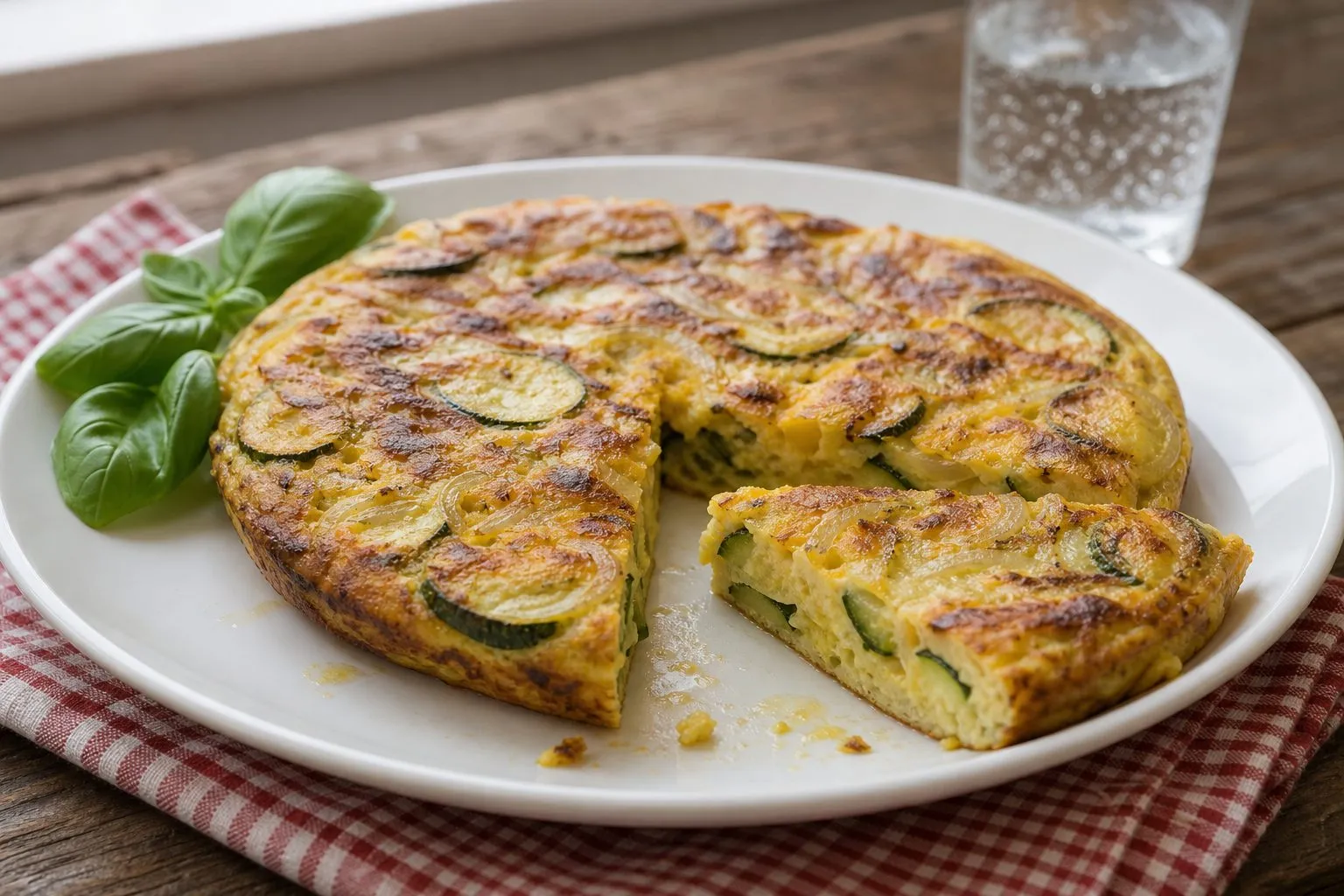
A frittata is an Italian egg dish: beaten eggs mixed with vegetables or cheese and cooked in a skillet as a flat, round cake. It is cooked on both sides without folding, then cut into wedges.
This recipe makes the zucchini frittata that is a staple of Italian home cooking. The zucchini is cooked in olive oil first to drive off its water, and grated Parmigiano-Reggiano goes into the eggs. The frittata cooks slowly under a lid over low heat and is flipped with a plate.
What is a frittata?
The Italian spelling is frittata. It comes from the verb friggere, “to fry”, and the Italian food site Dissapore gives the same origin. According to the Online Etymology Dictionary, the word comes from fritto, the past participle of friggere (“fried”). The verb goes back to a Latin verb meaning “to roast” or “to fry”, and it shares a root with the English word “fry”. English Wikipedia says the word originally covered any dish of eggs cooked in a frying pan.
In a 15th-century cookbook
The Swiss Italian-language broadcaster RSI reports that Libro de arte coquinaria, written in the mid-1400s by Maestro Martino (a cook from what is now the Swiss canton of Ticino), includes frittatas made with herbs and with eggs. What was new, it says, was that the book took up egg and vegetable dishes that had rarely appeared at noble banquets.
When and where it is eaten
In Italy, a frittata often appears at lunch or dinner as a main course (secondo piatto). It is also cut into small cubes for appetizers and buffets, and cold leftovers are tucked into bread as a panino. It is good warm or at room temperature, so it is a common choice for picnics and packed lunches.
The filling changes with the season and with what is in the house: vegetables, herbs, ham or bacon, cheese. Dissapore says that almost anything from the garden works, including asparagus, artichokes, fava beans, leeks, potatoes and wild greens.
How it differs from an omelet and a tortilla
A French omelet is folded, with the center left soft and creamy. The filling usually goes on top of the cooked egg before it is folded over. In a frittata the filling is mixed into the raw eggs first. The frittata stays flat and unfolded and is cooked through on both sides over gentle heat. After the first side is set, you either flip the whole thing with a plate or lid, or finish the top in the oven or under the broiler.
The Spanish tortilla de patatas is made the same way, with eggs and filling mixed and cooked as a round cake that is flipped with a plate. But its main ingredient is potato softened in plenty of olive oil, and Dissapore describes it as thicker than a frittata and made with more eggs.
The zucchini frittata as the base recipe
Four zucchini frittata recipes on the GialloZafferano blog platform, a major Italian recipe site, each served 4 and used 4 to 6 eggs and 2 to 3 zucchini (the two that gave weights used 250 g / 9 oz and 600 g / 1 lb 5 oz). Three of the four cooked onion with the zucchini, and two mixed Parmigiano-Reggiano into the eggs. Dissapore’s recipe also serves 4, cooks 2 zucchini and puts 50 g / 1¾ oz of Parmigiano in the eggs; it uses 8 eggs plus cream and is finished covered, without flipping. This article uses 6 eggs and 400 g / 14 oz of zucchini in a 24 cm / 9½ in skillet, for a frittata about 2 cm / ¾ in thick. Some recipes add milk to the eggs, but here it is eggs and cheese only.
Frittata recipe: ingredients (Serves 4 (one 24 cm / 9½ in skillet, 8 wedges))
Prep 20 min (includes 10 min to cool the cooked vegetables)Cook 30 minDifficulty Medium
Vegetables
- Zucchini2 (about 400 g / 14 oz)
- Onion½ (about 100 g / 3½ oz)
- Extra-virgin olive oil30 ml (2 Tbsp)
- Fine salt2 g (⅓ tsp)
Egg mixture
- Large eggs (about 300 g / 10½ oz without shells)6
- Parmigiano-Reggiano (finely grated from a block)50 g / 1¾ oz
- Fine salt2 g (⅓ tsp)
- Black pepper (coarsely ground)0.5 g (¼ tsp)
- Fresh basil leaves10 (about 5 g)
For cooking
- Extra-virgin olive oil15 ml (1 Tbsp)
Equipment
- Skillet (24 cm / 9½ in, nonstick with an undamaged surface; used for both the vegetables and the frittata)
- Lid for the skillet (24 cm / 9½ in; if you flip with the lid, it must be flat, with no screw sticking out in the middle of the inside)
- Flat plate (for flipping; at least 26 cm / 10 in across, flat, with a low rim)
- Serving plate (a separate, clean plate, not the one used for flipping)
- Mixing bowl
- Whisk or fork
- Silicone spatula or turner (one that will not scratch the nonstick coating)
- Cheese grater
- Wooden skewer
- Oven mitts (2)
Method
Cut the vegetables
Trim both ends off the zucchini and cut them into rounds 2–3 mm / ⅛ in thick (halve thick zucchini lengthwise first, then slice into half-moons). Halve the onion lengthwise and slice it thinly along the grain, about 2 mm / ⅛ in thick. Rinse the basil leaves and pat them dry.
Cook the onion
Put 30 ml / 2 Tbsp of olive oil and the onion in the 24 cm / 9½ in skillet over medium heat. When the onion starts to sizzle, lower the heat to medium-low and cook, stirring now and then, for 3–4 minutes, until soft and translucent. If it begins to brown, turn the heat down.
Cook and cool the zucchini
Add the zucchini and 2 g of salt, raise the heat to medium, and cook for 8–10 minutes, turning now and then. The zucchini should be tender with a few lightly browned spots, and no liquid should be left in the bottom of the pan. If there is liquid, keep cooking until it is gone. Spread the vegetables on a plate and let them cool for about 10 minutes, until warm enough to touch. Wipe out the skillet with a paper towel.
Make the egg mixture
Put the 6 eggs, 2 g of salt and 0.5 g of pepper in a bowl and beat with a whisk or fork until no clumps of white remain. Do not whip in air. Stir in the 50 g / 1¾ oz of Parmigiano, then add the cooled zucchini and onion and 10 basil leaves, torn by hand. Mix until the vegetables are spread evenly through the eggs.
Cook covered over low heat
Put 15 ml / 1 Tbsp of olive oil in the skillet and warm it over medium heat for about 1 minute, tilting the pan to coat the sides. Drop in a little egg; if it sets white at the edge right away, pour in all the egg mixture at once and level it so the vegetables are evenly spread. During the first minute, lift the edge in a few places with a spatula so that raw egg on top runs underneath. Cover, turn the heat to low, and cook for 8–12 minutes. It is ready to flip when the outer 2–3 cm / 1 in is firmly set, the center of the top is still soft but does not run, and the whole frittata slides as one piece when you shake the pan. Lift an edge with the spatula to check that the bottom is golden brown.
Flip it with a plate
Turn off the heat and work over the sink. If the frittata does not move when you shake the pan, slide the spatula down around the edge and underneath to loosen it all the way around. With oven mitts on both hands, turn the flat plate upside down over the skillet, press firmly on the middle of the plate with one hand, and hold the skillet handle with the other. Without hesitating, turn your wrists in one motion so the pan and plate swap places. Lift off the skillet and check that the frittata has landed on the plate. Return the skillet to the heat, then slide the frittata back into it from the plate, browned side up. To flip with a lid instead, use a flat lid in place of the plate, grip its knob, and turn it over the same way.
Cook the second side and rest
Cook uncovered over medium-low heat for 3–5 minutes. It is done when the underside is golden brown when you lift an edge, the center springs back when pressed lightly with the back of the spatula without any raw egg seeping out, and a skewer pushed into the center comes out with no raw egg on it. Slide the frittata onto a clean serving plate, not the plate used for flipping. Let it rest for 5 minutes, then cut it into 8 wedges.
Cut into wedges, it makes a lunch with bread and a salad. Cold, tucked into bread, it becomes a snack you can carry. Serve it with sparkling water or something else light.
The science: why low heat and a lid
Egg proteins push out water when overheated
Egg proteins set at different temperatures. Egg white starts to set a little above 60 °C / 140 °F, and yolk thickens at around 65–70 °C / 150–160 °F. Beaten whole egg turns creamy at about 70 °C / 160 °F and firms up above 80 °C / 175 °F. Keep heating and the proteins bond too tightly and squeeze out the water they were holding. That is why overcooked eggs turn crumbly, or weep liquid after cooking.
A frittata is about 2 cm / ¾ in thick, and heat reaches it only from the bottom of the pan. On strong heat the bottom egg overcooks and starts to burn before the center sets. The GialloZafferano blog recipes also warn that if the heat is too high, the surface colors before the inside is cooked. Cooking for 8–12 minutes over low heat in step 5 lets heat reach the center slowly without scorching the bottom.
The lid traps hot steam in the pan so the eggs are also warmed from above. The top is almost set when you flip it, so the egg is less likely to run out. Lifting the edge at the start to let raw egg flow underneath also helps the whole frittata cook at the same rate.
Drive off the zucchini’s water, then cool it
Zucchini is mostly water. Added raw, or not cooked enough, it releases water during cooking, which keeps the surrounding egg from setting and leaves the frittata soggy. It can also make the frittata crack when you flip it. That is why step 3 cooks the zucchini until no liquid is left in the pan. Dissapore likewise says to avoid moisture in a frittata and to drain fillings well.
The cooked vegetables are cooled before they are mixed with the eggs, because hot vegetables set the egg on contact and leave lumps. Dissapore also says to let freshly cooked vegetables cool before combining them with the eggs.
The science: what Parmigiano does
Parmigiano-Reggiano is a hard cheese made from cow’s milk and aged for a long time. In the eggs it first acts as seasoning. The cheese itself is salty, and aging breaks its proteins into amino acids, including glutamic acid, the source of umami, so it adds deep savory flavor to the eggs. This recipe uses only 2 g of salt in the egg mixture because the cheese adds salt too.
It also melts in a particular way. According to the food scientist Harold McGee, long-aged hard cheeses have proteins so finely broken down that they do not turn stringy when melted. Grated Parmigiano scatters through the eggs and blends into the whole frittata as it cooks. Diced mozzarella or another stretchy cheese would form stringy pockets and change the texture. Italian recipes also grate the Parmigiano into the eggs.
Safety
- Always turn off the heat, wear oven mitts and flip over the sink. Both the skillet and the plate are hot.
- This method cooks the frittata through to the center. Push a skewer into the middle and check that no raw egg comes out on it. Be especially careful when serving people who are pregnant, elderly, very young or immunocompromised.
- The plate used for flipping has raw egg on it. Serve on a separate, clean plate.
Variations by region and method
Onion frittata (frittata di cipolle)
Alongside the zucchini version, the other classic is a frittata made with onion alone. Dissapore traces it to home cooking in central and southern Italy, including Tuscany, Lazio and Campania. It is a familiar, homey taste that Italians also associate with Fantozzi, the hero of a series of Italian comedy films.
The GialloZafferano blog recipe slices 300 g / 10½ oz of yellow onion, cooks it soft in olive oil, and pours 4 beaten eggs over it. Dissapore’s recipe cooks the onion gently in butter, covered, over very low heat, then adds 1 tsp of sugar at the end for color, so it turns sweet and toasty. To make it with the quantities in this article, skip the zucchini and onion and use 300 g / 10½ oz of thinly sliced onion with 30 ml / 2 Tbsp of olive oil and 2 g of salt. Cook it covered over very low heat for 15–20 minutes, without letting it brown, until soft, and then go on to step 4. Neither source gives a time, so 15–20 minutes is an estimate for this article. It depends on the amount of onion and the heat, so judge by softness.
Pasta frittata (Naples)
In Naples there is frittata di maccheroni, made with boiled pasta bound with egg. According to Dissapore, it began as a humble way to use up leftover pasta, and the Neapolitan word maccarune covers pasta in general, not only macaroni. The traditional version has no tomato sauce, just eggs and cheese. Today it is a standard for outings and packed lunches, and many families boil extra pasta for it. Neapolitan fried-food and takeaway shops sell it in single-serving pieces.
Dissapore’s recipe boils 300 g / 10½ oz of pasta 2 minutes short of the package time, mixes it with 4 eggs, 50 g / 1¾ oz of Parmigiano, 100 g / 3½ oz of provola (a cheese in the mozzarella family, sometimes smoked) and 100 g / 3½ oz of Neapolitan salami, and cooks it over low heat for 5 minutes per side. English Wikipedia quotes the American food writer Arthur Schwartz as saying the Neapolitan frittata is always thin, but Dissapore says there is no rule: cooked thin it is crisp, and cooked about 4 cm / 1½ in thick it is soft.
Finishing in the oven
As a way to avoid flipping, Dissapore describes setting the bottom on the stove and then putting the whole skillet into a 180–200 °C / 355–390 °F oven, or under the broiler, for a few minutes to set the top. A skillet with a plastic or wooden handle cannot go in the oven, so use this method only with an ovenproof pan such as a cast-iron or carbon-steel skillet.
Substitutions
- Parmigiano-Reggiano: buy it in a block and grate it yourself. Some Italian recipes use Grana Padano (also a hard cow’s-milk cheese, aged for a shorter time) or Pecorino Romano (a hard sheep’s-milk cheese). Pecorino Romano is saltier, so cut the salt in the egg mixture to 1 g (this is a suggestion for this article). Pre-grated cheese from a shaker works too, but the aroma and savory flavor are weaker.
- Basil: some Italian zucchini frittata recipes use mint. Chop 10 mint leaves (about 2 g) and use those. Flat-leaf parsley also works.
- Zucchini: common green zucchini work well. In Italy, pale green, thin-skinned zucchini (zucchina bianca) are also used.
If something goes wrong
- It is watery and soggy: the zucchini still had water in step 3. Cook it until no liquid is left in the pan.
- The bottom is burned but the middle is raw: the heat was too high. In step 5, use low heat and a lid. If the top is slow to set, give it more time rather than more heat.
- It cracks or falls apart when flipped: mostly you flipped too early, before the bottom and edge had set. Wait until the whole frittata slides as one piece when you shake the pan. A worn pan surface that makes the bottom stick can also be the cause.
- It is crumbly and weeping liquid: it was overcooked. For the second side, take it out after about 3–5 minutes, as soon as a skewer comes out without raw egg. It keeps cooking from residual heat after you remove it.
Storage
It is best freshly cooked or cooled to room temperature.
- Refrigerator: once cool, wrap in plastic or put in a container and eat within 2 days. Eat it cold, or reheat it in a skillet or microwave. It also makes a good panino.
- Freezer: not recommended. Dissapore advises against freezing it because the egg turns spongy when thawed.
More from Italy
Sources
- cucina preDiletta (GialloZafferano Blog): "Frittata di zucchine bianche" (Italian)
- Allacciate il grembiule! (GialloZafferano Blog): "Frittata di zucchine e basilico ricetta facile con trucco" (Italian)
- In cucina con Zia Debby (GialloZafferano Blog): "Frittata di zucchine" (Italian)
- Forno e fornelli (GialloZafferano Blog): "Frittata di zucchine" (Italian)
- Vale cucina e fantasia (GialloZafferano Blog): "Frittata con le cipolle ricetta facile e velocissima" (Italian)
- Dissapore: "Frittata di zucchine, la ricetta per farla morbida in padella" (Italian)
- Dissapore: "14 regole e trucchi per una frittata perfetta" (Italian)
- Dissapore: "Frittata, la ricetta base" (Italian)
- Dissapore: "Frittata di cipolle, la ricetta veloce e saporita" (Italian)
- Dissapore: "Frittata di maccheroni, la ricetta di recupero più famosa della cucina napoletana" (Italian)
- RSI (Swiss Italian-language broadcaster): "Libro de arte coquinaria" (Italian)
- Online Etymology Dictionary: "frittata" (English)
- Wikipedia: "Frittata" (English)
The text and recipe above were put together independently after comparing these sources.