Tortilla de patatas (Spanish potato omelet)Tortilla de patatas recipe
tortilla de patatas
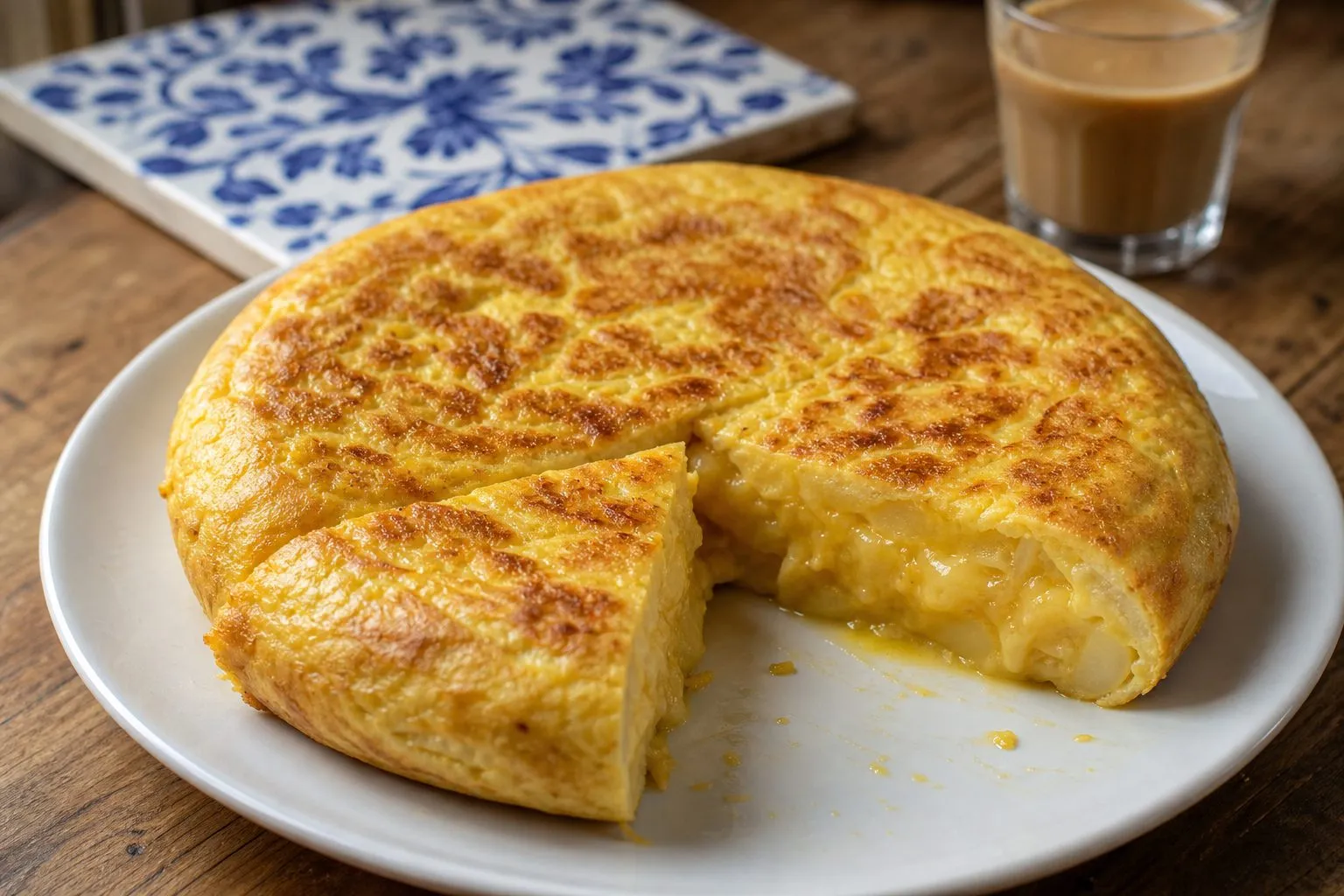
Tortilla de patatas is a thick, round omelet made with potatoes, eggs and onion. In Spain a big one sits on the bar counter, ready to be cut into wedges and eaten as a snack. In English it is often called a Spanish omelet or Spanish tortilla.
What makes it good is how the potatoes are cooked: poached gently in plenty of olive oil rather than fried, until they are tender. They then soak briefly in the beaten egg before the tortilla is cooked until the center is soft and just set.
What is tortilla de patatas?
The Spanish name means “potato tortilla”. Tortilla comes from torta (something flat and round) plus a diminutive ending, and in Spain it means an omelet cooked from eggs. The Mexican tortilla, a thin flatbread made from corn flour and similar doughs, comes from the same word but is an entirely different food. The dish is also called tortilla española, “Spanish tortilla”.
When and where it is eaten
It is eaten all over Spain, at home and in bars. In bars it is cut into pieces and served as a tapa (small plate), or tucked into bread as a bocadillo (a baguette sandwich). It is good warm or at room temperature, and some Spanish recipes say leftovers are better eaten cold than reheated.
Where it came from
The potato was unknown in Spain until the Spanish reached South America. There are several stories about how the tortilla began.
The best-known legend dates to the First Carlist War (a civil war over the Spanish succession). While the Carlist general Tomás de Zumalacárregui was besieging Bilbao, hungry soldiers are said to have combined potatoes from nearby fields with eggs from local farms. An article in the Spanish newspaper El Norte de Castilla presents this as a legend, notes that some accounts place it in 1835, and says other theories seem to have more documentary support.
The same article describes the Memorial de Ratonera, an anonymous document addressed to the Cortes (parliament) of Navarre in 1817. It pleads for the poor mountain farmers and describes a tortilla of two or three eggs shared among five or six people, because the women are good at stretching a few eggs into a large, thick tortilla with potatoes, bread scraps and other additions.
The historian Javier López Linage, in his work on the history of the potato, says the earliest written mention of this kind of tortilla is in Villanueva de la Serena in Extremadura. According to an article in El Debate, the clue is a letter about potato bread written in 1798 by a priest of that town, which suggests the dish may have begun as something like a potato bread. Which story is right has not been settled.
Onion or no onion?
In Spain the question of con cebolla (with onion) or sin cebolla (without) comes up all the time. Some cooks use onion, such as the chef Karlos Arguiñano, whose ratio is 6 eggs, 3 potatoes and 1 onion. In Betanzos, in Galicia, the town’s tortilla contest does not accept entries with onion.
This recipe uses onion. Slowly cooked onion adds sweetness and moisture, and the tortilla stays moist even when it cools. For the onion-free version, see the regional variations below.
Tortilla de patatas (Spanish potato omelet) recipe: ingredients (Serves 4 (one 20 cm / 8 in tortilla))
Prep 25 min (including soaking the potatoes and letting them rest in the egg)Cook 40 minDifficulty Medium
Potatoes and onion, poached in oil
- Potatoes (waxy potatoes hold their shape; floury ones break down more)500 g / 1 lb 1½ oz peeled (4 medium)
- Onion150 g / 5¼ oz (1 small)
- Olive oil (you will also use some of this oil in steps 6 and 7)400 ml (1⅔ cups)
- Fine salt4 g (⅔ tsp)
Egg mixture
- Whole eggs5 large (about 250 g / 9 oz without shells)
- Fine salt2 g (⅓ tsp)
Cooking
- Olive oil (the oil from step 3) (to start the first side)15 ml (1 Tbsp)
- Olive oil (the oil from step 3) (after flipping)5 ml (1 tsp)
Equipment
- Pot (for poaching the potatoes and onion in oil; about 20 cm / 8 in across and at least 8 cm / 3 in deep)
- Nonstick skillet (for cooking; 20 cm / 8 in across (about 16 cm / 6¼ in at the base), with an undamaged nonstick surface)
- Flat plate (for flipping; at least 24 cm / 9½ in across, with a low rim)
- Serving plate (a separate, clean plate, not the one used for flipping)
- Colander and bowl (to drain and catch the oil)
- Rubber spatula or wooden spoon
- Oven mitts (2)
Method
Slice the potatoes and onion
Peel the potatoes, cut them lengthwise into quarters, then slice crosswise 2–3 mm / ⅛ in thick. Soak in water for 5–15 minutes, drain in a colander, then wrap in a clean kitchen towel and pat very dry. Halve the onion lengthwise and slice along the grain, 2–3 mm / ⅛ in thick.
Cook the onion first
Put 400 ml of olive oil and the onion in the pot and set over medium heat. When fine bubbles rise around the onion, lower the heat to low and cook for 10 minutes, stirring now and then. The onion should be soft and translucent. If it starts to brown, lower the heat further.
Add the potatoes and poach
Add the potatoes and sprinkle with 4 g of salt. Set the heat to medium-low and keep the oil at a gentle simmer, with small bubbles rising quietly around the potatoes. Cook for 15–20 minutes, turning the potatoes over now and then with a wooden spoon. If the bubbles become large and lively, or the potatoes begin to brown, lower the heat. Turn off the heat when the potatoes crumble softly under the spoon and have hardly taken on any color.
Drain and cool
Set the colander over the bowl, tip in the potatoes and onion, and let them drain for about 5 minutes. Let them cool until warm enough to touch. From the drained oil, set aside what you need for steps 6 and 7.
Soak in the egg and rest
In a large bowl, break the 5 eggs, add 2 g of salt, and beat gently, cutting through the whites until they are loosened but not frothy. Add the potatoes and onion and mix. Lightly crush about a third of the potatoes against the side of the bowl with a wooden spoon. Leave for 5 minutes.
Cook the first side
Warm 15 ml / 1 Tbsp of the oil from step 3 in the 20 cm / 8 in skillet over medium to medium-high heat for about 1 minute. The oil is ready when its surface shimmers and a drop of egg sizzles and sets at once. Pour in the mixture all at once. For the first 20–30 seconds, shake the pan and stir the mixture 2 or 3 times with a wooden spoon, then push the edges inward to shape a round. Reduce to medium-low and cook for 2–4 minutes. It is ready to flip when the whole tortilla moves as one piece when you shake the pan back and forth, and the outer 1 cm / ½ in is set.
Flip it with a plate
Turn off the heat and work over the sink. Put on both oven mitts. Turn the flat plate upside down over the skillet, press the middle of the plate firmly with one hand, and hold the skillet handle with the other. Without hesitating, flip your wrists in one quick movement so the pan and plate trade places. Lift the skillet away and check that the tortilla has landed on the plate. Return the skillet to the heat, swirl in 5 ml / 1 tsp of the oil from step 3, and slide the tortilla back in with the browned side up.
Finish the second side and rest
Tuck the edges in with a wooden spoon to keep a round shape and cook over medium-low heat for 1–2 minutes. Press the center lightly with the back of the spoon: if it wobbles but no raw egg seeps out, it is soft-set. For a firmer tortilla, cook over low heat for 3–4 minutes, until the center no longer wobbles when pressed. Slide it onto the clean serving plate, not the plate you used to flip, and let it rest for 5 minutes before cutting.
Cut into wedges, it goes well with a café con leche (coffee with plenty of milk) in the morning or before lunch, and as a tapa with cold beer or wine.
The science: why cook the potatoes slowly in plenty of oil
Tender inside, no hard crust outside
Potato cells are packed with starch granules. When heated, the granules absorb water and swell from the 60s °C (140–155 °F), turning pasty (gelatinization). With more time near 100 °C / 212 °F, the pectin that holds the cells together loosens, and the potato becomes soft enough to crumble.
Even in hot oil, the water inside the potato keeps its interior at about 100 °C / 212 °F. But if the oil is too hot, the surface dries out first, forming a hard skin and browning. The Spanish consumer magazine Consumer says that when the oil is too hot the outside colors while the inside stays raw, and when it is too cool the potatoes soak up too much oil.
That is why step 3 keeps the bubbles small and quiet and takes 15–20 minutes. The potatoes gelatinize and soften all the way through without browning on the surface. This is far below the temperature of deep-frying oil (170–180 °C / 340–355 °F). Spanish cooks call this confitar (to cook in oil) or pochar (to soften over low heat). Using plenty of oil and turning the potatoes now and then cooks them evenly and keeps the pieces touching the pot wall from scorching.
Soak, then pat dry
Soaking the sliced potatoes in step 1 rinses the surface starch from the cut faces, so the slices are less likely to stick together in the oil. Patting them very dry afterward matters because water spatters dangerously in hot oil.
The science: why the potatoes rest in the egg, and how a soft center sets
Resting in the egg binds potato and egg together
After 5 minutes in the egg, the mixture clings to the surface of the soft potatoes, and the crushed potato blends into the egg and thickens it slightly. When cooked, the egg and potato stay together instead of separating, so the tortilla is less likely to break when flipped.
If the potatoes are too hot, though, the egg starts to set on contact and the cooked tortilla turns dry. That is why step 4 cools them until they are comfortable to touch. For the same reason, do not whip air into the eggs: an aerated mixture sets faster and turns out less moist.
Stop before the center passes about 70 °C / 160 °F
The proteins in an egg set at different temperatures. Egg whites begin to set a little above 60 °C / 140 °F, and yolks thicken at around 65–70 °C / 150–160 °F. Beaten whole egg turns creamy at about 70 °C / 160 °F, firms up above 80 °C / 175 °F, and with further heating squeezes out water and turns crumbly.
A soft-set tortilla is one taken off the heat when the edge and surface are firm but the center is still creamy. The center keeps heating a little from residual heat after it leaves the pan. The 5-minute rest in step 8 lets the center settle so it does not run when you cut. Stop cooking a little before the doneness you want.
Safety
- When working with hot oil, pat the potatoes very dry and stay by the stove. Use a deep pot so that the oil and vegetables do not fill it to the brim. When you drain the oil in step 4, put the colander and bowl on a stable surface.
- When flipping, always turn off the heat, wear oven mitts and work over the sink. Both the skillet and the plate are hot.
- A soft-set egg still carries a risk of Salmonella food poisoning. The health authority of the Madrid region sets the standard for restaurants as a center temperature of 70 °C / 160 °F for 2 seconds, or 63 °C / 145 °F for 20 seconds. The center of a soft-set tortilla may not reach that. The same authority advises cooking eggs thoroughly, especially in summer, and not serving soft-set tortilla to pregnant women, older adults, young children or people with weakened immune systems. If any of these people will be eating, cook the tortilla in step 8 until the center no longer wobbles.
- The plate you used for flipping has raw egg on it. The same authority warns against serving on that plate, so use a separate clean one.
Regional variations
Without onion (sin cebolla)
Leave out the onion and use 600 g / 1 lb 5 oz of potatoes. Skip step 2. Warm 400 ml of olive oil over medium heat, add one potato slice, and when fine bubbles form around it, add the potatoes and 4 g of salt and continue from step 3. The flavors of potato, egg and olive oil come through directly.
Betanzos style (very soft center)
The tortilla of Betanzos, a town in Galicia, is known for being cooked so soft that the center is almost raw. In 2018 the rules of the town hall’s long-running tortilla contest stated for the first time that entries containing onion could not compete. In the town’s tradition the ingredients are only potato, oil, egg and salt.
In the Betanzos-style recipe from the Spanish newspaper El Español, the potatoes are sliced thin, 1–3 mm / up to ⅛ in, and fried in oil at around 180 °C / 355 °F until lightly colored in places. Egg yolks are added to the whole eggs, and each side is cooked over a very low heat for just 45 seconds. To come close at home, use the onion-free version with thinly sliced potatoes, cook step 6 for 1 minute and step 8 for 30 seconds to 1 minute, and remove the tortilla while the center is still almost liquid. Because you will be eating nearly raw egg, use fresh eggs, and skip this version if you are among the people listed under “Safety” above.
Substitutions
- Olive oil. Spanish recipes use extra-virgin olive oil, but also a mild refined olive oil (often sold as light or pure olive oil) or sunflower oil. Extra-virgin has a stronger aroma, while refined olive oil and sunflower oil let the potato flavor come forward.
- Potatoes. Spanish recipes recommend varieties such as Monalisa and Kennebec. With whatever you can find, a waxy potato keeps its shape better and leaves distinct slices, while a floury potato breaks down more and blends more easily with the egg.
If something goes wrong
- The potatoes are crisp and do not blend with the egg. The oil in step 3 was too hot. If the bubbles get lively or the potatoes begin to brown, lower the heat.
- It cracks or collapses when flipped. The usual cause is flipping too early, before the base and edges have set. Wait until the whole tortilla moves as one piece when you shake the pan. Cooking right away without soaking in the egg also makes the potatoes and egg separate and break apart.
- It sticks to the skillet. The oil and pan were not hot enough in step 6. Drop in a bit of egg and make sure it sets at once before pouring in the mixture. A damaged nonstick surface also causes sticking.
- It is dry and firm all the way through. It was overcooked, or the potatoes were too hot when they went into the egg. Take it out after 1–2 minutes in step 8 and let residual heat finish it, and in step 4 cool the potatoes until warm to the touch.
Storage
It is at its best anywhere from fresh out of the pan to cooled to room temperature, and it is best eaten soon after it is made.
- Refrigerator: wrap what you will not eat right away in plastic wrap and refrigerate. The health authority of the Madrid region advises discarding tortilla that is more than 2 days old. It also advises not making soft-set tortilla ahead: eat it right away and discard any leftovers.
- To eat: rather than reheating refrigerated tortilla, eat it cold or tuck it into bread as a bocadillo.
More from Spain & Portugal
Sources
- El Español (Cocinillas): "Tortilla de patatas con cebolla, videorreceta con todos los trucos" (Spanish)
- ¡HOLA!: "Tortilla de patatas: la receta que siempre sale bien" (Spanish)
- Directo al Paladar: "Tortilla de patatas con cebolla: receta tradicional española paso a paso" (Spanish)
- Consumer (Fundación Eroski): "Trucos para hacer una tortilla de patatas perfecta" (Spanish)
- El Español (Cocinillas): "Tortilla de patata al estilo de Betanzos, la receta en vídeo para no fallar" (Spanish)
- Directo al Paladar: "Betanzos prohíbe oficialmente la cebolla en su célebre tortilla de patatas" (Spanish)
- Directo al Paladar: "La regla 6-3-1 de Karlos Arguiñano para hacer la tortilla de patatas perfecta" (Spanish)
- El Norte de Castilla (print edition PDF): "El arte de la tortilla española" (Spanish)
- El Debate: "El origen de la tortilla de patatas: ¿dónde y cuándo se inventó?" (Spanish)
- Vozpópuli: "Día de la Tortilla de Patatas: historia, origen y por qué se celebra el 9 de marzo" (Spanish)
- Comunidad de Madrid: "Precauciones con las tortillas" (Spanish)
The text and recipe above were put together independently after comparing these sources.