Pan con tomatePa amb tomàquet recipe
pa amb tomàquet
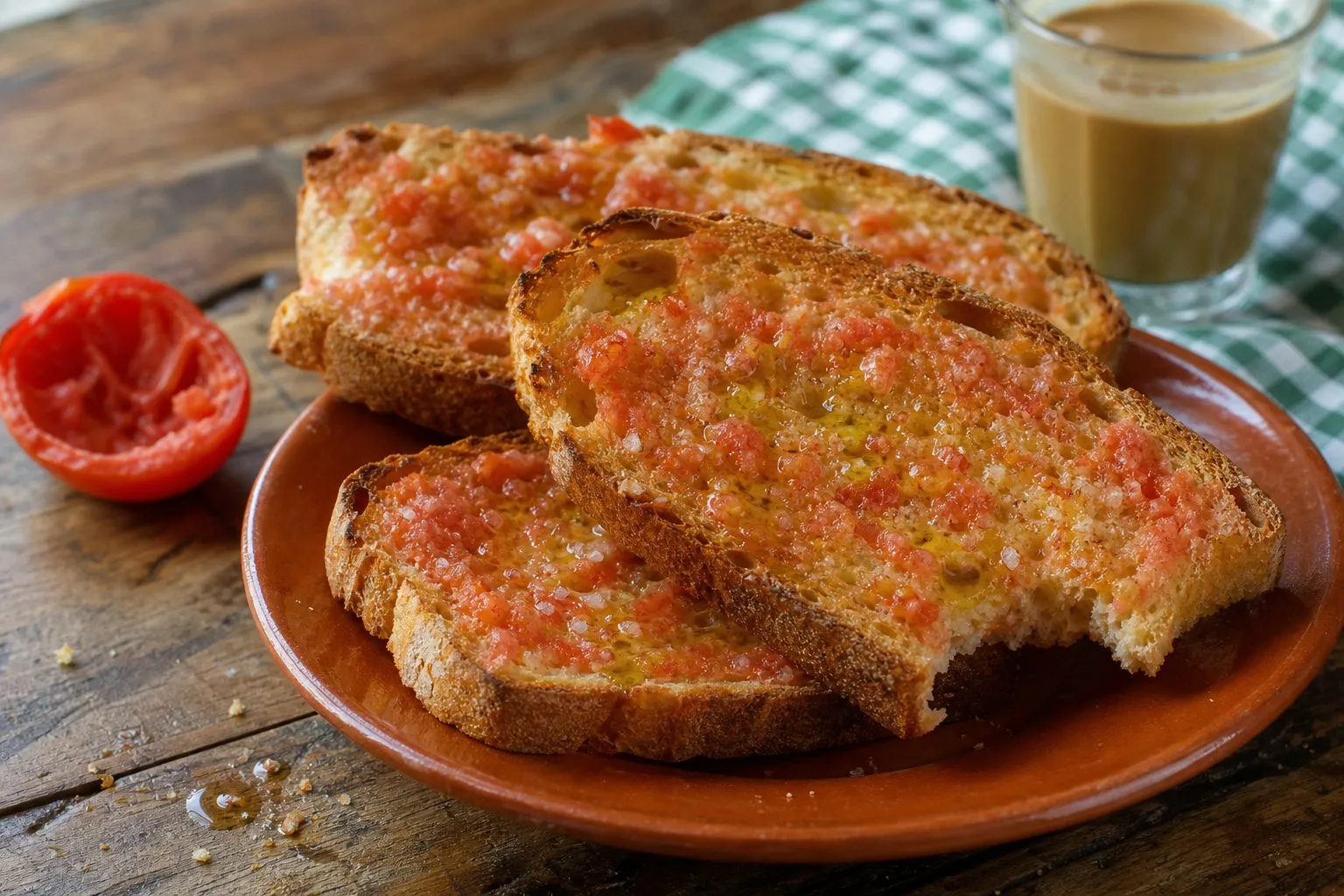
Pan con tomate is toasted bread rubbed with the cut face of a ripe tomato, then finished with salt and olive oil. In Catalonia it is the most ordinary way to eat bread, at breakfast and at lunch and dinner too.
There are only four ingredients: bread, tomato, salt and olive oil. That is why the way you toast the bread and how ripe the tomato is matter so much.
What is pan con tomate?
In Catalan it is pa amb tomàquet, in Spanish pan con tomate; both mean “bread with tomato”. It is also widely known as pantumaca, and it is eaten on Mallorca and the other Balearic Islands as well.
Probably from the 19th-century countryside
The tomato came from the Americas, so the dish is not ancient. Catalonia’s cultural heritage website says the first records date from the 19th century.
The food historian Néstor Luján places its first appearance in Catalan writing in 1884, and describes it as a farmers’ summer trick to soften dry, hardened bread. The heritage site cites the same view: a dish born in the countryside, once tomatoes were plentiful, as a way to soften dry bread. In Luján’s view, it does not go back hundreds of years.
According to a piece in the Catalan newspaper Ara, the 1884 mention comes from the writer Pompeu Gener and was surfaced by Luján in a 1984 newspaper article. The photographer Leopold Pomés also gave 1884 as the earliest record in his 1985 book Teoria i pràctica del pa amb tomàquet (“The theory and practice of pa amb tomàquet”). The same article adds that the passage is hard to find in Gener’s own work.
The chef Toni Massanés, who heads the Alícia food research foundation, says the interesting question is less when it began than why it did. His view is that the dish grew up alongside farmers who kept saving seed from their own tomatoes. Ara also notes that bread with garlic and olive oil existed before tomatoes joined it.
When and where it is eaten
In Catalonia the classic setting is breakfast, with a café con leche (coffee with plenty of milk). Top it or serve it with cured ham, cheese, sausage or a tortilla española (Spanish potato omelet), and it becomes a meal or a bite to go with wine.
Pan con tomate recipe: ingredients (Serves 2 (4 slices))
Prep 10 min (bring the tomatoes to room temperature first)Cook 5 min (toasting the bread)Difficulty Easy
Bread
- Rustic country bread (pan de payés or pain de campagne) (crusty, with an open, airy crumb; slice 1.5 cm / ⅝ in thick)4 slices (about 200 g / 7 oz)
Tomato and finish
- Ripe tomatoes (medium, deep red, giving slightly when pressed; at room temperature, not straight from the fridge)2 (about 300 g / 10½ oz)
- Fine salt (about 0.4 g per slice)1.5 g (¼ tsp)
- Extra-virgin olive oil (10 ml / 2 tsp per slice)40 ml (2 Tbsp + 2 tsp)
Equipment
- Toaster oven (or a stovetop toasting rack or a nonstick skillet)
- Knife and cutting board
Method
Cut the tomatoes
Wash and dry the tomatoes and remove the stems. Cut each one in half from top to bottom, through the stem end and the blossom end, and check that the jelly around the seeds is showing on the cut surface. If the tomatoes were in the fridge, let them come to room temperature before using.
Toast the bread
Cut the bread into four slices 1.5 cm / ⅝ in thick. Toast in a toaster oven for 3–5 minutes, until the surface is light golden and feels crisp and hard when pressed while the inside still springs back. If the bread dries out all the way through, the tomato will not soak in and the slice turns into a rusk. On a stovetop toasting rack or in a dry nonstick skillet, toast over medium heat for 1–2 minutes per side.
Rub the tomato on the bread
While the toast is still hot, press the cut side of a tomato half against one side of a slice and rub it in small circles all the way to the edges. Use half a tomato per slice. The bread grates off the flesh and jelly, and the skin is left in your hand. Aim for a surface that is faintly red and moist, not a thick, jam-like layer. Discard the skins.
Add the salt
Sprinkle 1.5 g of salt over the four slices (about 0.4 g each). The tomato juice dissolves it and spreads it across the surface.
Dress with olive oil and eat at once
Pour 10 ml / 2 tsp of olive oil over each slice from a height of about 10 cm / 4 in, covering the whole surface. Eat right away, before the bread softens.
At breakfast, serve it with a café con leche. With ham or cheese on top, red wine or cava (Spanish sparkling wine) goes well.
The science: why toast the bread first
Toast makes the bread a grater
Toasting dries the surface into a hard, rough face. At the same time the proteins and sugars in the bread undergo the Maillard reaction, which browns the surface and adds a toasty aroma.
When you press and move the cut tomato over this rough surface, the bread acts like a grater. It scrapes off the soft flesh and the jelly around the seeds and leaves the tough skin in your hand. In the method Pomés describes in Ara, the skin is something to hold, not something to spread.
Untoasted soft bread tears when rubbed. The cook Maria Nicolau also says you need bread sturdy enough to take the rubbing. Toast it all the way through, on the other hand, and the juice can no longer soak in, so it pools on top. That is why step 2 aims for a crisp surface with a crumb that still gives: the surface scrapes the flesh off, and the softer crumb underneath drinks the juice.
Rub on hot toast, then eat immediately
Once the toasted surface takes up tomato juice it begins to soften. Salting and oiling right away, and eating right away, lets you taste both the crisp surface and the juice-soaked crumb. The chef Jordi Vilà also recommends working quickly.
The order of salt first, then oil, is the one Pomés gave. He says salt sprinkled after the oil slides off, while salt sprinkled first sticks to the tomato; on the damp surface it dissolves and spreads. Many other sources do the opposite, oiling first and finishing with salt, and some cooks use coarse salt such as Maldon. Cooks differ on this.
One side or both?
In Pomés’s method both sides of the bread get tomato. The Directo al Paladar article notes that some people rub one side and others both. Here, one side keeps a 1.5 cm slice from going soft. If you do both sides, rub straight from the toaster and eat at once.
The science: tomato varieties, and choosing tomatoes anywhere
Hanging tomatoes kept through winter
Catalans prize a tomato called tomàquet de penjar (“hanging tomato”), stored hung up so it lasts through the months when fresh tomatoes are scarce. A smaller storage type, ramellet (“little bunch”), is also known, notably from Banyalbufar on Mallorca.
According to a paper by researchers at the Polytechnic University of Catalonia and colleagues, hanging tomatoes keep for more than four months thanks to a mutation that changes how they ripen. During storage glucose, fructose and citric acid fall, while malic acid and glutamic acid (a source of umami) rise. Local people are reported to prefer the stored, aged fruit to the freshly picked one.
The Barcelona cook Ada Parellada says these tomatoes have been selected over generations so that the skin is easy to pinch and the flesh comes away on the bread. Massanés, mentioned above, also thinks the first pan con tomate used soft, juicy tomatoes that rubbed off easily.
Umami lives around the seeds
Glutamic acid, the main umami compound in tomatoes, is more concentrated in the inner part, with the seeds and surrounding jelly, than in the firm outer flesh. A 2007 study from the UK found that the inner part gave a stronger umami aftertaste. Halving the tomato in step 1 to expose the jelly, and rubbing it in during step 3, moves that jelly and soft flesh onto the bread.
Choosing tomatoes outside Catalonia
Hanging tomatoes are hard to find almost everywhere outside Catalonia. Spanish cooks say that elsewhere you should simply use the best ripe, fragrant tomatoes you can get.
- Pick ripe ones. They should be deep red and give slightly when pressed. Hard, greenish tomatoes are sharper, and their flesh does not transfer to the bread.
- Keep them out of the fridge. Dani Roca, a cook with restaurants in Barcelona and Madrid, advises keeping tomatoes in a cool, dry place rather than the fridge. The food scientist Harold McGee also reports that chilling weakens tomato aroma. If yours were in the fridge, take them out a few hours ahead.
- Medium size. Large tomatoes are awkward to hold for rubbing, and cherry tomatoes take several per slice. Medium or small (cocktail-size) tomatoes are easiest.
Variations: garlic, ham and other regions
With garlic
Some cooks rub the toast with a cut garlic clove before the tomato. For four slices, halve two cloves (about 10 g) lengthwise and use half a clove per slice. The Directo al Paladar recipe works this way.
Even in Catalonia, garlic divides opinion. Nicolau says garlic only suits toasted bread, and Vilà skips it when serving the toast with a tortilla or fried fish. This recipe leaves it out, so the tomato and olive oil come through clearly and nothing clashes with the toppings.
With cured ham
Directo al Paladar singles out cured ham as an especially good partner. After step 5, lay 15–20 g (½–¾ oz) on each slice. Jamón serrano or jamón ibérico, cheese, fuet (a thin dry sausage) and tortilla are all common toppings.
On Mallorca and in Andalusia
According to Ara, on Mallorca and Ibiza tomato is sometimes sliced and sandwiched in the bread instead of rubbed on. Andalusian breakfasts include tomato toast too. Directo al Paladar writes that in Catalonia the tomato goes on first, whereas in Andalusia the correct order is said to be olive oil first.
Substitutions
- Bread. The Catalan choice is pa de pagès, a farmhouse loaf with a firm crust and a slightly tangy, spongy crumb full of holes. A pain de campagne or a bâtard comes close. The Spanish articles do not recommend baguette, and soft sandwich bread tears when rubbed.
- If the tomato is too firm to rub. The Spanish-born chef José Andrés says you can grate it if rubbing does not work. Grate the cut side on the coarse holes of a box grater, leaving the skin in your hand, and discard it. Mix 1.5 g salt into the pulp, spread about 30 g (2 Tbsp) on each toasted slice, and add the oil. Note that Ara lists grating among the methods to avoid.
- Olive oil. Spanish cooks recommend a mild, slightly sweet extra-virgin oil from the arbequina olive. If you cannot find it, use any Spanish extra-virgin olive oil.
- Salt. Ordinary fine salt works. Coarse or flaky salt keeps a little crunch; in that case, oil first and salt last.
If something goes wrong
- The toast is soggy. It was under-toasted or you rubbed too much. Toast until the surface is crisp, and rub only until it turns faintly red. It will also soften if it sits.
- The tomato skin tears and the flesh will not transfer. The tomato is underripe or cold. Use a ripe room-temperature tomato, and grate it if it is firm.
- It tastes sour. Underripe tomatoes are the main cause. Ara also names pale, unripe tomatoes among the bad ways to make it.
- The bread is too hard for the juice to soak in. It was toasted through. Take it out as soon as the surface colors.
Safety
Fresh toast, toaster-oven racks and skillets get very hot. Use tongs or oven mitts to take the bread out. The tomato goes onto the bread skin and all, so wash it well first.
Storage
This is made to order and eaten at once; it does not keep.
- Tomatoes: wrap the cut face of a leftover half in plastic wrap, refrigerate, and use by the next day. Bring to room temperature before using.
- Bread: if you will not use it right away, slice it 1.5 cm / ⅝ in thick, wrap each slice and freeze. Toast from frozen in a toaster oven, adding 1–2 minutes.
More from Spain & Portugal
Sources
- Directo al Paladar: "Cómo hacer el auténtico pan con tomate o pa amb tomàquet, el desayuno estrella de la cocina catalana" (Spanish)
- Directo al Paladar: "Los consejos de José Andrés para hacer el mejor pan con tomate" (Spanish)
- Directo al Paladar: "Así se hace el auténtico pa amb tomàquet con los consejos de un chef barcelonés: cómo convertir en manjar el pan con tomate" (Spanish)
- Directo al Paladar: "Los secretos de un verdadero 'pa amb tomàquet' a la catalana (y los tres bares de Barcelona donde probar el más auténtico)" (Spanish)
- Ara (Spanish edition): "Radiografía del pan con tomate: sacrilegios, detractores y el origen de este plato tradicional catalán" (Spanish)
- Time Out Barcelona: "Hacer un buen pan con tomate no es tan fácil como parece: los chefs nos explican sus secretos" (Spanish)
- Gran Enciclopèdia Catalana: "tomàquet" (Catalan)
- Patrimoni Cultural (Generalitat de Catalunya): "Cooking in the 19th-century" (English)
- UPCommons (Universitat Politècnica de Catalunya): "Sugar-and-acid profile of Penjar tomatoes and its evolution during storage" (English)
- Umami Information Center: "Tomatoes" (English)
The text and recipe above were put together independently after comparing these sources.