TteokbokkiTteokbokki recipe
떡볶이
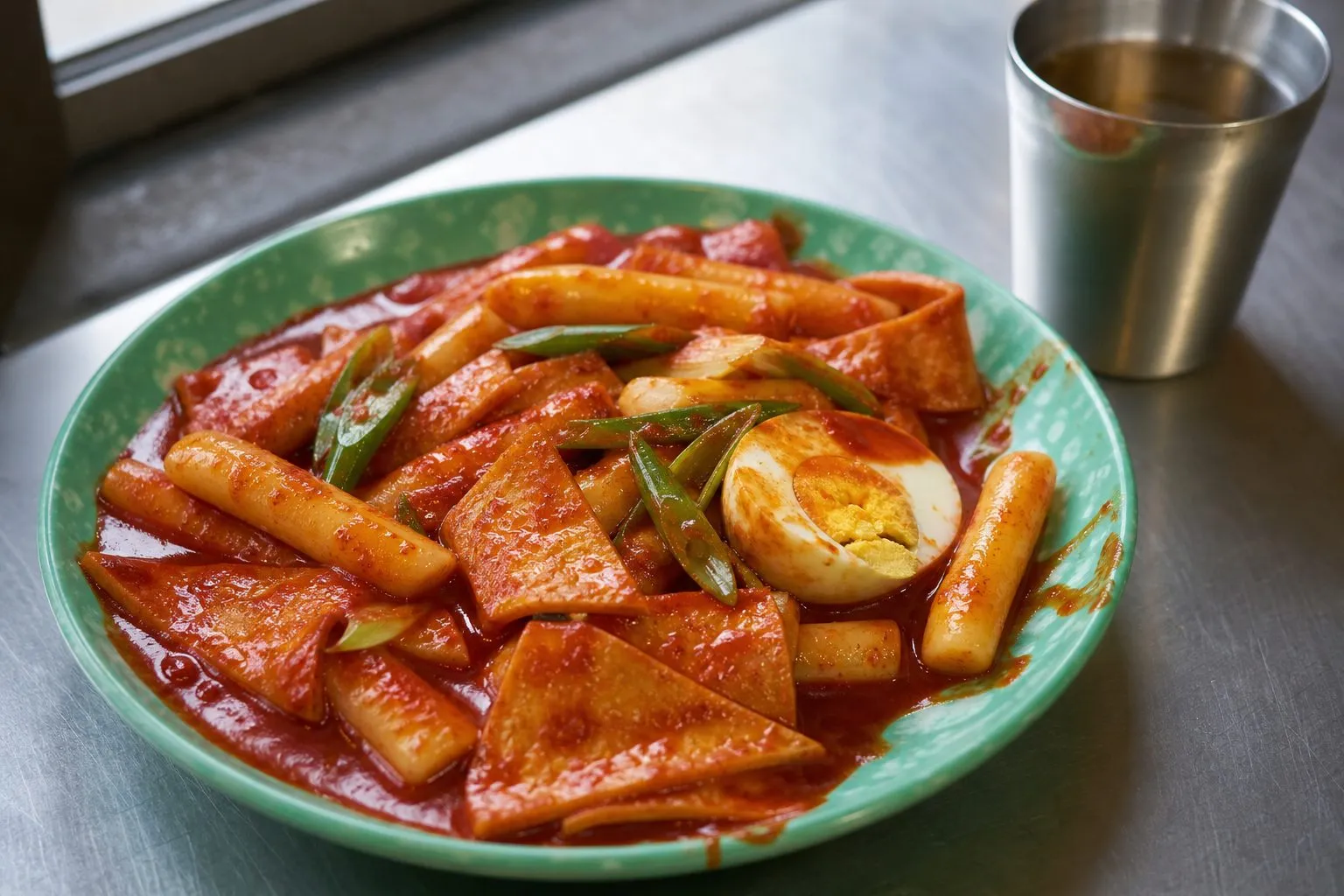
Tteokbokki is a Korean snack of cylindrical rice cakes simmered in a sweet and spicy gochujang sauce. Fish cake (eomuk) and boiled eggs are the classic partners in the pot. It has long been a quick bite after school or on a break from work, sold at bunsikjip (casual snack shops) and market stalls.
This recipe uses rice (not wheat) cakes and is based on market-style recipes posted on 10000 Recipe (만개의레시피), a large Korean recipe site, among other Korean sources. You dissolve the sauce in a kombu broth, then simmer the rice cakes until the sauce turns thick and clingy.
What is tteokbokki?
The Korean name is 떡볶이. Tteok (떡) means rice cake, and bokki (볶이) means “something stir-fried”. Today it is usually simmered, but the name remembers the days when it was a stir-fry.
A royal stir-fry of rice cakes in soy sauce
The Encyclopedia of Korean Culture describes tteokbokki as a dish of white cylindrical rice cakes stir-fried with beef and vegetables. You cut the rice cakes to about 4 cm / 1½ in, soak them, and stir-fry them with beef, dried zucchini, bean sprouts, shiitake, onion and carrot.
Korean newspaper and magazine articles point to Siuijeonseo, a cookbook from the late Joseon dynasty, which records a dish of rice cakes stir-fried with beef, sesame oil, soy sauce, scallions and mushrooms. With its costly ingredients and soy sauce seasoning, it was not food for ordinary people. Today it is called gungjung (royal court) tteokbokki. Ko Young, a food culture researcher writing for the web magazine of Korea’s Rural Development Administration, also says tteokbokki was top-class cuisine until the 1950s.
Sindang-dong stalls and the gochujang version
The red, gochujang-flavored tteokbokki was born after the Korean War. The best-known story is that Ma Bok-rim (died 2011) began selling it at a street stall in Sindang-dong, Seoul, in 1953. Coverage of the commemorative tteokbokki stamps issued by Korea Post in 2023 repeated this account.
On how it started, Bravo My Life, a Korean magazine for seniors, tells this story. Ma Bok-rim visited a newly opened Chinese restaurant and accidentally dropped a rice cake, brought to celebrate the opening, into a bowl of jajangmyeon. The rice cake, coated in black bean paste (chunjang), tasted better than expected, so she began seasoning with gochujang in place of the expensive chunjang. Some articles say she cooked over a coal briquette fire with a sauce that combined gochujang and chunjang. Ko Young, on the other hand, puts the arrival of red tteokbokki in the late 1950s and names Ma Bok-rim as one of the leading women who sold tteokbokki at street stalls.
Tteokbokki shops clustered in the Sindang-dong alleys in the late 1970s. Bravo My Life reports that the alley became famous after appearing on an MBC TV program, and that in the mid-1970s shops with DJs spinning records drew crowds. When gas stoves became common, “instant tteokbokki”, simmered at the table with vegetables and ramen noodles, became Sindang-dong’s signature.
Rice cakes (ssal-tteok) and wheat cakes (mil-tteok)
Tteokbokki is made with either rice cakes (쌀떡, ssal-tteok), made from non-glutinous rice, or wheat cakes (밀떡, mil-tteok), made from wheat flour. After the Korean War, flour became widely available through aid, and wheat cakes, cheaper than rice ones, came into use. This coincided with a period when the government encouraged people to eat flour instead of rice.
Allure Korea, a Korean women’s magazine, calls the charm of rice cakes their soft, chewy texture, and adds that choosing between rice and wheat cakes is a matter of strong personal taste. This recipe uses rice cakes.
Tteokbokki recipe: ingredients (Serves 2)
Prep 25 min (including soaking the rice cakes)Cook 30 min (including boiling the eggs)Difficulty Easy
Rice cakes and broth
- Tteokbokki rice cakes (tteok) (rice cakes (ssal-tteok) in cylinders about 1.5 cm / ⅝ in thick and 5 cm / 2 in long)300 g / 10½ oz
- Water400 ml (1⅔ cups)
- Dried kombu5 g (one 10 cm / 4 in square)
Add-ins
- Flat fish cake (eomuk) (Korean flat fish cake sheets)2 sheets (about 100 g / 3½ oz)
- Long green onion (daepa)1 stalk (about 100 g / 3½ oz)
- Eggs (to be hard-boiled)2 large (about 100 g / 3½ oz shelled)
Sauce
- Gochujang (Korean chili paste)36 g (2 Tbsp)
- Gochugaru (Korean chili flakes)9 g (1½ Tbsp)
- Granulated sugar12 g (1 Tbsp)
- Soy sauce (regular (not light))10 ml (2 tsp)
- Garlic (grated)5 g (1 tsp)
To finish
- Mullyeot (Korean starch syrup)42 g (2 Tbsp)
Equipment
- Wide, shallow pot or skillet (about 24–26 cm / 9½–10 in across and at least 5 cm / 2 in deep)
- Small saucepan (for boiling the eggs)
- Wooden spatula
Method
Boil the eggs
Bring plenty of water to a boil in a small saucepan. Lower the 2 eggs, straight from the fridge, into the water with a ladle. Boil over medium heat for 10–12 minutes, until hard. Cool in cold water and peel.
Prepare the rice cakes
Separate any rice cakes that are stuck together and rinse them briefly under running water. Freshly bought, soft rice cakes can go in as they are. Rice cakes that have turned hard in the fridge, and frozen ones, should soak in water for about 10–20 minutes, until the surface dents slightly when pressed with a finger. Don't leave them in too long, or the surface will fall apart easily.
Cut the add-ins
Cut each fish cake sheet into 4 triangles. Slice the white part of the green onion diagonally about 1 cm / ½ in thick, and cut the green parts into 5 cm / 2 in lengths.
Make the broth and dissolve the sauce
Put 400 ml of water and the 5 g of kombu in the pot and set over medium heat. Once it boils, simmer over medium-low heat for 5 minutes, then remove the kombu. Add 36 g gochujang, 9 g gochugaru, 12 g sugar, 10 ml soy sauce and 5 g garlic. Stir with a wooden spatula until no lumps of gochujang remain, then bring to a boil over medium heat.
Simmer the fish cake and onion whites
When the sauce boils, add the fish cake and the white onion slices. Simmer over medium heat for 2 minutes.
Simmer the rice cakes and add the eggs
Add the rice cakes and simmer over medium heat for 8–10 minutes. Rice cakes stick to the bottom, so keep stirring, scraping the base of the pot. After about 5 minutes, add the boiled eggs and roll them around to coat them in sauce. The dish is done when a skewer slides easily through a rice cake, the sauce has reduced by about half, and a line drawn across the bottom with the spatula stays open for 1–2 seconds. If the bottom looks about to scorch before the sauce reduces, lower the heat.
Finish with syrup and onion greens
Drizzle in 42 g of syrup and stir for 30 seconds to 1 minute, until glossy. Add the green onion tops and toss for 10–20 seconds, until coated but not yet wilted, then turn off the heat.
Crack a boiled egg in the sauce and mix the yolk in as you eat, if you like. Fried snacks (twigim) go well on the side, and a cold drink such as barley tea suits it.
The science: why hard rice cakes are soaked, then simmered
Rice cakes harden through starch retrogradation
Tteokbokki rice cakes are made by steaming non-glutinous rice flour and pounding it until it turns sticky. Steaming makes the rice starch granules absorb water, swell and loosen into a soft mass. This is called gelatinization.
As the gelatinized starch cools, its molecules slowly realign and set like crystals, squeezing water out. This is retrogradation, the same thing that makes bread stale. The food scientist Harold McGee explains that bread staling is fastest at refrigerator temperatures. The Korean wiki The Wiki likewise says rice cakes stale faster than bread and turn hard in the fridge. This is a different process from simply drying out.
Soak first, then simmer in the sauce
Warming retrograded starch loosens the crystals and restores some softness. Stale bread softens when reheated, and in the same way hard rice cakes soften to the center when simmered in the sauce.
If you simmer rice cakes that are hard to the core without soaking, though, the surface falls apart before the inside warms through. Soaking first lets the surface take up a little water and makes stuck-together cakes easier to separate. The traditional stir-fried version in the encyclopedia and the TV cooking segment both soak the rice cakes before using them. Too long a soak makes the surface too soft, so stop when it dents slightly under your finger.
Glutinous rice cakes, such as mochi, are a different thing. McGee notes that the starch of glutinous rice is almost entirely highly branched amylopectin, which turns very soft and sticky when cooked. Non-glutinous rice also contains amylose, a straight-chain starch, and is less sticky when cooked. Glutinous rice cakes melt and lose their shape when simmered in sauce, so tteokbokki uses non-glutinous rice cakes.
The science: how the sauce thickens
The ideal tteokbokki sauce is thick and clings to the rice cakes. The thickness comes mainly from three things.
The first is evaporation. Boiling the 400 ml of water down by about half concentrates the sauce. The second is starch released from the surface of the rice cakes. As they simmer, a little of the gelatinized surface starch dissolves into the sauce and thickens it. The third is gochujang plus sugar and syrup. Gochujang is a fermented paste made from glutinous rice, malt and other ingredients, and it contains starch and sugar. Sugar gets stickier as it reduces.
A sauce rich in starch and sugar scorches on the bottom more easily the further it reduces. That is why you keep stirring and scraping the base with a wooden spatula. The syrup goes in at the end, following the market-style recipes, to make the sauce glossy.
Regional and shop variations
- Royal court tteokbokki: the old-fashioned, not-spicy version, seasoned with soy sauce and stir-fried with beef and vegetables.
- Instant tteokbokki: the style popularized in Sindang-dong, simmered at the table in a pan with vegetables and ramen noodles.
- Soupy tteokbokki: some versions use more broth and finish like a soup. The one posted on 10000 Recipe as the method of the Korean chef Baek Jong-won is soupy.
- Soy sauce and oil tteokbokki: on TV, Baek Jong-won also showed an “oil tteokbokki” with no gochujang, stir-fried with soy sauce, gochugaru and sesame oil.
- Other flavors: cheese, cream, jajang, curry and rosé (tomato and cream) versions are spreading too.
Substitutions
- Tteokbokki rice cakes. Look for refrigerated or frozen ones at Korean grocery stores or online. Long cylindrical rice cakes (garae-tteok) work too: cut them into 5 cm / 2 in lengths, then cut each piece in half lengthwise. Glutinous rice cakes such as mochi melt when simmered and are not a substitute.
- Eomuk. This is a flat Korean fish cake. Use the same weight of any flat fried fish cake. If it is thick, cut it 1 cm / ½ in wide.
- Gochugaru. Korean chili flakes are mild and slightly sweet. Most other ground chilies, such as cayenne or crushed red pepper, are much hotter, so don’t swap them one for one. Start with 1 tsp (about 2 g) and add more to taste. The color will be paler.
- Mullyeot. This is Korean starch syrup. Some Korean recipes use oligosaccharide syrup instead. If you have none, add 1 Tbsp (12 g) more granulated sugar. The gloss will be less pronounced.
If something goes wrong
- The rice cakes are hard inside, or the surface melts. Simmering hard rice cakes as they are breaks down the surface before the center softens. Soak cakes that have hardened in the fridge first. Conversely, rice cakes soaked too long have a surface that melts easily.
- The sauce scorches. You stopped stirring, or the heat was too high. Once the rice cakes are in, keep stirring and scraping the bottom with a wooden spatula, and lower the heat as the sauce reduces.
- The sauce stays thin. It has not reduced enough. Simmer until a line drawn across the bottom with the spatula stays open for 1–2 seconds.
- The green onion goes limp. You added the green parts too early. Add them just before turning off the heat and toss briefly.
Safety
The reduced sauce bubbles and can spatter. Keep your face and hands back from the pot. Cooked rice cakes are very hot inside and can be a choking risk, so cut them smaller and let them cool before serving to small children and older adults.
Storage
Tteokbokki is best eaten freshly made. As it cools, the starch in the rice cakes retrogrades and hardens, and the rice cakes soak up the sauce, leaving less of it.
- To prepare ahead: the sauce ingredients (gochujang through garlic) can be mixed and refrigerated the day before. Boiled eggs can be kept in their shells in the fridge until the next day.
- Leftovers: store in an airtight container in the fridge until the next day. To reheat, return to a pot with 30–45 ml (2–3 Tbsp) of water and warm over medium-low heat, stirring, until the rice cakes are soft all the way through.
More from Korea & Asia
Sources
- 만개의레시피: "간단 쌀떡볶이 레시피 진한 떡볶이 만드는 법 떡볶이양념 비법" (Korean)
- 만개의레시피: "꾸덕꾸덕 달콤하고 매콤한 시장표 쌀떡볶이 비법레시피" (Korean)
- 만개의레시피: "백종원 떡볶이 , 국물 떡볶이" (Korean)
- MBC 연예: "왔다, 백종원! <마이 리틀 텔레비전> 속 '2종 떡볶이' 레시피는?" (Korean)
- MBC 연예: "[맨도롱 쿡방] 드라마 속 유연석표 "매운 떡볶이" 레시피는?" (Korean)
- 브라보마이라이프: "‘辛 아닌 新’ 떡볶이① 근본 있는 음식이었네" (Korean)
- 디지털데일리: "K-푸드 대표 '떡볶이·순대' 기념우표 나온다" (Korean)
- 위키트리: "70년 전 골목에서 시작된 열풍… 한 번 맛보면 계속 찾게 된다는 '한국 음식'" (Korean)
- 한국민족문화대백과사전: "떡볶이" (Korean)
- 농촌진흥청 그린매거진: "떡볶이, 이촌향도의 좌판과 함께 떠올리기" (Korean)
- 더위키: "떡" (Korean)
- 얼루어 코리아: "밀떡 말고 쌀떡볶이" (Korean)
The text and recipe above were put together independently after comparing these sources.